
AT A GLANCE
Business Process Outsourcing used to sit in the cheap seats. The BPO meaning in 2026 is completely different. It has shifted to the control room where your customer experience, operations, data, and margins are quietly decided. If you still treat it as a discount hotline, you are leaving speed, resilience, and innovation on the table. This guide shows you how to flip BPO from cost line to core engine for your agenda, so you do less busywork and more actual strategy.
Introduction
Business process outsourcing used to be a back‑office hack: move work somewhere cheaper, hope quality holds, repeat. That playbook is finished. In 2026, the BPO meaning has flipped from “extra hands” to “extra operating system”. It is now a way to redesign how your organisation runs end-to-end. That includes everything from customer experience to finance, risk, data, and the speed at which you can execute and change.
Decoding Next-Gen BPO Operations
This guide walks through that new reality step by step. You will see what Business Process Outsourcing is in practice, how different models work, and where the real value sits when you mix human expertise, AI, and global talent. You will get a simple framework for deciding when external support makes strategic sense. You will also learn how the three‑talent model (people, AI, gig) is reshaping the future of BPO operations and what to ask providers.
What is BPO? The Essential Definition
At its core, Business Process Outsourcing is both a concept and a service. Simply put, it describes a relationship where one organisation (the client) delegates specific tasks or processes to an external partner (the provider) to carry them out on its behalf.
However, this is not extra work bolted onto everyday duties. These are operations you would normally handle yourself, but choose not to manage in‑house. Just because they absorb time, effort, and resources you could put to better use elsewhere. The work remains important, sometimes even business‑critical, yet it is not truly core to your differentiation.
What Is BPO About in Practice? Think Outcomes, Not Org Charts
In healthcare, for example, it means patient support and claims are handled end-to-end, with fewer delays, smoother billing, and clear answers instead of administrative headaches. In e‑commerce, by contrast, customer service and order management run smoothly, so purchases are tracked, issues resolved, and returns processed without derailing growth. On social platforms, it shows up as content, comments, and communities being kept clean, on‑brand, and under control before issues have a chance to blow up your feed.

The real objective is to build a partnership that integrates into your operating model. This requires more than a buying decision. It demands the right language, structure, and questions to position outsourcing as a strategic lever of business design.
In other words, by trusting the right specialist BPO, you let internal teams focus on the work that actually moves the needle. At the same time, your partner rolls up their sleeves and delivers the results you agreed on together, efficiently, reliably, and at scale.
BPO in 2026: From Back-Office Costs to a Business Advantage
Here, it is worth noting that historically, many executives treated outsourcing as a cost‑cutting lever to offload repetitive back‑office tasks to lower‑cost locations. Over the last decade, that view has shifted towards long‑term, strategic partnerships, where BPO providers act as extensions of your own organisation and share accountability for outcomes.
In this context, in 2026, BPO’s meaning is no longer about accessing cheap labour. It is about plugging your business into a ready‑made operating system that covers people, processes, data, and technology, delivered as a service. All to achieve engineered performance, resilience, and predictable services.
From Tasks to Outcomes
The new approach is simply to delegate outcomes, not just tasks. You agree on service levels and KPIs while your partner designs the engine and keeps it running. This is business process outsourcing explained for the C‑suite: you stay accountable for strategy and the customer promise, while they take accountability for execution, capacity, and continuous optimisation.
BPO vs Other Outsourcing Models
Yes, there are a few options, and all are closely related to Business Process Outsourcing. When you look at external delivery models, the key question is whether you want extra hands, a fully owned outcome, or something in between. This is where BPO, managed services, staff augmentation, and in‑house teams play very different roles in how work gets done and who is accountable for the results. It is worth getting to know the most common ones before deciding which one best fits your needs and strategy.
| Model | What it is | Best when |
|---|---|---|
| BPO | End‑to‑end ownership of defined processes with shared KPIs and continuous improvement. | You want outcomes (CSAT, AHT, FCR) to improve, not just extra headcounts. |
| Managed services | Provider runs a platform or function within a defined scope (for example, IT infrastructure). | You need a stable, utility‑like service with tight SLAs and limited process redesign. |
| Staff augmentation | You “rent” people who work inside your existing processes, tools, and management structure. | You like your operating model and governance; you just need more capacity or niche skills. |
| In‑house teams | Fully owned, fully controlled operations run by your employees. | The process is core IP or a key source of competitive differentiation, and you want direct control. |
BPO Market Size and Growth in 2026
Ultimately, how can you think about managed services vs BPO? It comes down to depth. The first option keeps things running to an agreed standard, while Business Process Outsourcing re-engineers and elevates how the work gets done. If you only want more bodies, staff augmentation works. When you expect real transformation in how a process performs, you are firmly in BPO territory.
And this space is continually growing. In 2026, global Business Process Outsourcing revenue is projected to reach around US$435 billion, rising at roughly 3 % per year to approach US$490 billion by 2030 (Statista). And according to other research, the growth trajectory is expected to accelerate further in the coming years, with a projected CAGR of 9.9 % from 2026 to 2033. This surge is being driven by the rapid adoption of digital transformation initiatives, as organisations increasingly deploy cloud platforms, AI‑driven analytics, and automation tools (Grand View Research).
Types of Business Process Outsourcing
When companies’ decision‑makers talk about the types of business process outsourcing, they usually mean the scope of work that is handed to a partner, without necessarily trying to categorise or label it more formally.
This is BPO services explained in day‑to‑day terms: some functions sit visibly on the front-line with your customers, others quietly keep the back-office running, and a third segment goes deeper into specialist, knowledge‑heavy work.

Here are the core groups and the main types of business process outsourcing you are likely to encounter:
Front-Line BPO: Where Your Customer Feels It
Front‑office BPO stands right where your consumers are, and typically includes customer service, sales support, technical assistance, and sometimes elements of marketing or social media management. This is the space where response times, tone of voice, and first‑contact resolution can win or lose loyalty in seconds.
Typical front‑office engagements range from everyday “where is my order?” questions to complex troubleshooting, renewals, and outbound sales or retention campaigns, often delivered across multiple languages, cultures and jurisdictions. A strong partner brings resources, proven playbooks, training, and quality frameworks. The best one increasingly blends skilled human agents with AI CX capabilities that truly deliver. With such an approach, high‑volume queries are automated, while nuanced, high‑value cases are handled by experienced people who can actually solve them.
Back-Office BPO: The Engine Room You Don’t See
Back‑office BPO is the operational engine room: bookkeeping, payroll, data entry, IT support, and similar internal functions that quietly keep the business moving. These tasks do not sit within the revenue-generating core. Still, they are critical for compliance, accuracy, and a smooth day‑to‑day operation, especially when you are dealing with high volumes and strict regulatory rules.
Beyond these foundations, many organisations also outsource more specialised functions such as procurement, legal administration, content moderation, or data annotation. In each case, expert teams take on the repeatable, process‑heavy work so your core staff can focus on decisions, relationships, and projects that drive growth, rather than chasing tickets and forms.
Knowledge Process Outsourcing: The Expert Layer
Ultimately, Knowledge Process Outsourcing steps in, moving beyond just handling tasks to generating insight. It includes data analysis, market and competitive research, financial modelling, and selected legal or compliance activities. These are areas where specialised talent and deep domain expertise matter more than sheer volume.
In practice, KPO teams might build dashboards and performance reports, analyse markets ahead of a launch, or support legal departments with complex document review. The real difference from traditional BPO is depth: instead of just following a process, KPO providers interpret information, make recommendations, and sometimes challenge assumptions, acting as an extension of your strategy, finance, or legal teams rather than a pure back‑office processor.
BPO in Motion: Different Models and Opportunities
With a clear understanding of what BPO is and its most common categories, the next question is how you want it to work in practice. Different collaboration models shape who you partner with, how much you delegate, how and from where services are delivered, and what you expect in return. Think of these as dials you can tune rather than rigid boxes.
The models available are diverse, ranging from more traditional setups to outcome-based partnerships that link fees directly to measurable business impact.

Relationship-Based Models
Relationship‑based models define who you work with and how concentrated your bets are. Single sourcing puts most of your scope with one partner, giving deep alignment and simple governance, but less flexibility if you need to change quickly. Multi‑sourcing spreads work across several providers, boosting resilience and specialisation. At the same time, staff augmentation lets you “rent” extra people into your own tools when you just need more hands or niche skills. Most mature organisations end up with a hybrid: a strategic anchor BPO for core volumes, plus a few specialist or regional partners for new markets and seasonal peaks.
Service-Delivery Models
Service‑delivery models decide where the work is done. Onshore BPO keeps teams in the same country as your core operations, maximising cultural fit and regulatory comfort, but at a higher labour cost. Nearshore moves work to neighbouring or similar‑time‑zone countries to balance savings with easy collaboration, while offshore outsourcing goes further afield to tap global talent and stronger cost advantages, especially for large, standardised workloads or 24/7 coverage. In practice, most mature programmes use a right‑shoring mix, matching each process to the geography that best fits cost, risk, and customer expectations.
Among many strong global BPO destinations, a few stand out as real “shining stars” as major outsourcing hubs with different strengths and specialisations. As noted by Forbes Business Council, these include the Philippines, Poland and Colombia, among others. Beyond these, countries that also count globally in outsourcing and BPO include Romania, Portugal, Greece, Egypt and Turkey, all of which hold strong and growing positions in the industry.
Operational-Focus Models
Operational‑focus models clarify what you want a partner to run. Managed services hand over an entire function, such as a contact centre or finance operations, on a long‑term basis, with shared KPIs and continuous improvement. Project‑based outsourcing is narrower and time‑bound, used for migrations, rollouts, or audits. At the same time, virtual assistance is the lightest option, with remote specialists handling defined tasks for leaders or teams. Across these, the key question is whether you need a long‑term operating engine or targeted help to get a specific job done.
Technology-Driven Models
Technology‑driven models focus on how work gets done. Automation‑led engagements use RPA and workflow tools to strip out repetitive steps, reduce errors, and free people for more complex or empathetic tasks. Cloud‑based delivery wraps processes in SaaS platforms for faster deployment, easier scaling, and cleaner data flows. AI‑ and analytics‑enabled models then add predictive analytics, personalisation, and real‑time insights to tune performance, so the BPO becomes a co‑pilot for digital transformation, not just an execution arm.
Outcome-Based Partnerships
Outcome‑based BPO changes how you pay and what you optimise for. Instead of paying only for capacity, you link a portion of fees to metrics like CSAT (customer satisfaction), NPS (Net Promoter Score), revenue uplift, or error reduction, which aligns everyone around value delivered rather than tickets closed. These models demand clear baselines, solid data, and mutual trust. Still, when they work, they create a true performance partnership where your provider is financially motivated to improve the same numbers your board cares about and brings ideas, not just services.

Why Companies Choose BPO: Strategic Benefits
Business process outsourcing has shifted from a blunt cost‑cutting tool to a strategic lever for better operations. Done well, it boosts efficiency, resilience, and capability simultaneously, turning support functions into a quiet growth engine rather than a drag on focus and resources. Leaders today use BPO to free internal teams for higher‑value work while a specialist partner runs the machinery of day‑to‑day execution.
Lean, High‑quality Operations
At a practical level, BPO helps you run leaner without lowering the bar on quality: processes are redesigned, automated where it makes sense, and delivered on shared, pay‑for‑use platforms instead of expensive, fragmented in‑house setups. You also gain instant access to specialised expertise, including domain specialists, multilingual teams, robust compliance, and advanced AI‑driven tooling, that would take years and significant capex to build on your own. Because capacity can scale up or down with demand, from seasonal peaks to new market launches, you avoid locking into permanent headcount or infrastructure while still giving customers fast, reliable service around the clock.
Stronger, Safer Operating Backbone
Beyond cost, expertise, and scale, BPO strengthens the spine of your operating model. Multi‑site, 24/7 delivery and multilingual support reduce single‑point‑of‑failure risk and make it easier to serve customers wherever they are. Plug‑and‑play tooling and analytics accelerate digital transformation, delivering automation and real‑time insight as part of the service rather than as a separate multi‑year project. Mature providers also bring established governance, certifications, and risk frameworks, so you are sharing operational, regulatory, and security risk with a partner that lives and breathes compliance every day.
BPO advantages and disadvantages go hand in hand: you gain scale and specialised expertise, but you give up some direct, day‑to‑day control. It works best when supported by strong governance, cultural alignment, and clear performance measures, and it may not fit highly strategic, experimental, or brand‑defining work where tight control and in‑house learning are essential.
When BPO Makes Strategic Sense
BPO creates real advantage when it is applied deliberately, not reactively. Used well, it becomes an extension of your operating model. The questions below give leaders a simple lens to decide when outsourcing is the right strategic move for them and why.
When should BPO be on your radar? Start by evaluating these five factors:
| Factor | What to look for |
|---|---|
| Process maturity | Processes that are standardised, well‑documented, and repeatable, so a partner can execute reliably at scale; highly experimental work may need to be stabilised first. |
| Strategic importance | Activities that are not core differentiators but are high-volume and operationally critical are strong candidates for BPO. |
| Volume predictability | Demand patterns you can roughly forecast so the partner can design capacity, SLAs, and pricing; very volatile volumes may require a phased or highly flexible model. |
| Technology readiness | Solid systems, clean data, and APIs that support smooth integration and unlock automation and analytics from day one; fragmented stacks should include a joint modernisation plan. |
| Cost‑benefit threshold | A clear ROI case once transition effort, change management, and governance are included, covering both run‑rate savings and improvements in quality, speed, or customer experience. |
The Future of Business Process Outsourcing
The three‑talent BPO model is the future of how scaled operations will run and thrive. The centre of gravity is now simply shifting from cheap seats and light automation to intelligent outsourcing engines where smart people, increasingly autonomous AI, and an on‑demand global crowd act as one system.
Put simply, the future of BPO comes down to this: three types of talent, one unstoppable BPO machine that encompasses:

Human Bedrock
Emotionally intelligent specialists who handle complex conversations, edge cases, and high‑stakes decisions across multiple languages and channels, bringing nuance and empathy to every interaction.

AI Layer
Chatbots, voicebots, and generative AI agents that manage triage, routing, summarisation, knowledge retrieval, and quality checks, taking on more work autonomously while elevating what humans do. AI in BPO simply becomes a commodity.

Elastic Gig Workforce
A curated global pool that activates on demand to cover surges, niche languages, and specialised tasks like content review or data labelling, giving brands instant, flexible scale.
Sci-fi? Not really. This three‑talent model is already live in scaled programmes today. A global Conectys gaming client needed a rapid content moderation launch for a multinational fantasy league. The one with millions of users and real-time content. Conectys activated its gig workforce, deployed seasoned CX specialists, and integrated AI moderation, achieving full global coverage in less than three weeks.
As AI takes on more of the work, data protection, model oversight, and clear AI governance become non‑negotiable parts of any serious BPO strategy.
How to Evaluate a BPO Partner: Your BPO Shortlist Filter
Once you understand what BPO is and how it can support your strategy, the next step is choosing a partner that delivers more than short‑term cost savings. In practice, BPO’s meaning shifts from “outsourced vendor” to “strategic operator”.
Technology as the First Lens
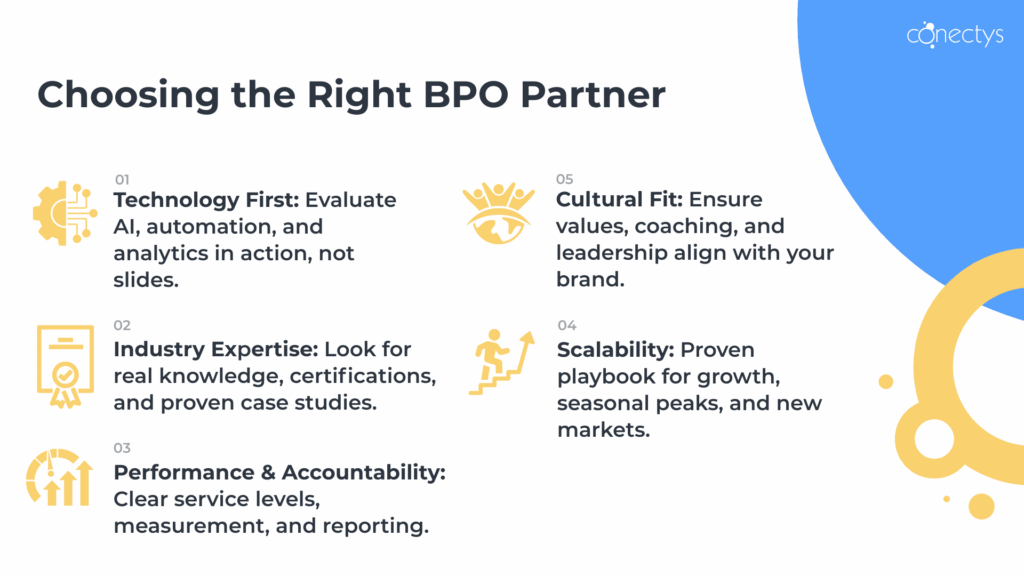
When you evaluate a BPO partner, the first lens is their technology stack. You are not just buying people. You are plugging into their AI, automation, and analytics capabilities, and those need to fit with your own systems and roadmap. Ask them to show how their tools perform in live environments and how they automate routine tasks, monitor quality, and surface actionable insights, rather than relying on polished slide decks.
Industry Expertise That Goes Beyond Buzzwords
Next comes vertical expertise. A strong BPO provider understands your industry’s language, regulations, and customer expectations, whether that is HIPAA in healthcare, PSD2 in financial services, or complex returns in e-commerce. Case studies, certifications, and conversations with their operations leaders should make it obvious that they know your world, not just generic outsourcing jargon.

Clear Performance and Accountability
You also need real performance guarantees. The best companies are confident in setting service levels for response times, accuracy, and customer satisfaction, and they can explain exactly how they measure success and how often they report. You are looking for a rhythm of data and reviews that lets you steer the partnership, along with a clear plan for what to do if they fall short.
Cultural Fit That Actually Works
Then there is cultural alignment. Even if the numbers look great, the relationship will struggle if their values, leadership style, and front-line coaching approach clash with your brand. Listening to sample calls, meeting team leads, and understanding how they hire, train, and recognise people will tell you whether they can truly act as an authentic extension of your company.
Scalability Without Compromise
Finally, test their scalability story. Growth spurts, seasonal peaks, and new market launches are where weak BPO setups crack, so you want partners with a proven playbook for hiring, training, and adding technology capacity fast. Ask them to walk you through specific ramp‑ups they have managed and how they protected quality while volumes surged.
Conclusion
Overall, Business Process Outsourcing has become a global growth engine, empowered by cloud, AI, and automation that turn once-manual tasks into always-on, data-driven operations. Fueled by international talent and smarter technology, it is no longer just a cost-cutting factor but a leading catalyst for progress. Today, BPO services quietly run critical parts of how many modern organisations operate and scale, with trends pointing to even greater transformative impact. The future of Business Process Outsourcing simply looks bright and full of promise.
The options are immense, ranging from front- and back-office work to knowledge process outsourcing to outcome-based, automation-led, and multi-shore models. That is exactly why discipline matters. The real advantage emerges when you prepare properly: define what is truly core, stabilise the processes you want to hand over, and choose a partner whose capabilities, data, and culture you would trust to represent your brand.
FAQ
What is BPO in simple terms?
Business Process Outsourcing (BPO) is the outsourcing of specific tasks or processes to an external specialist to run them more efficiently and at scale. In practice, it lets you refocus internal teams on strategic work while a partner handles repeatable, operations-heavy activities. This is business process outsourcing explained in a way leaders can link directly to their operating model and understand the modern BPO meaning in practice.
What’s the difference between BPO and call centres?
Call centres used to focus on a single channel, primarily phone-based customer support and telesales. The BPO meaning is broader: it can include call centres, back-office operations, content moderation, finance processes, and more. If you think of call centres as a single spoke, BPO is the wheel that connects multiple channels and processes.
How much does BPO typically cost?
BPO pricing depends on scope, geography, technology stack, and service levels. Many organisations achieve 30–50% BPO cost savings compared with fully in-house operations, especially at scale. The real goal, however, is value: better quality, speed, resilience, and access to capabilities you would struggle to build alone.
Can BPO work for small and mid-sized companies?
Yes. Modern BPO services, as explained for 2026, are no longer just for Fortune 500 enterprises. Flexible, modular solutions let small and mid-sized firms tap expert talent, AI in BPO, and shared platforms without committing to large, fixed cost bases.
What happens to my in-house team if we implement BPO?
The intent is not to “replace” your team, but to redeploy them into higher-value work. These are critical business process outsourcing benefits: routine tasks are handed off to your partner, while in-house experts focus on strategy, innovation, customer journeys, and cross-functional initiatives that differentiate your brand.
How do I ensure data security with BPO?
Look for providers with strong compliance certifications (such as ISO standards, SOC 2, or HIPAA where relevant), proven data governance frameworks, and regular third-party audits. Clear policies on access control, encryption, and AI model governance should be part of every contract.
What’s the typical implementation timeline?
For standard, mature processes, BPO implementation usually takes 60–90 days from design to go-live. Highly customised, multi-region operations or complex managed services can take 4–6 months to stabilise, especially when deep integration, AI in BPO, or new e-commerce outsourcing solutions are involved.