
AT A GLANCE
AI is rapidly becoming the extra pair of eyes and ears in healthcare. It is sharpening human judgment, catching risks earlier, and documenting care in ways regulators can trust. It is not a replacement, but an augmentation. For patients, it is a chance at a more timely, accurate diagnosis. Medical data annotation makes this possible. In a world drowning in raw data, only precisely labelled and structured information can power AI that truly saves lives instead of adding noise. Finding the right partner for that work is as close as healthcare gets to winning the lottery.
Introduction
The healthcare sector is embracing digital intelligence in everyday practice. AI technology is increasingly helping clinicians make better diagnoses and treatment decisions, spot risks earlier, and reduce the burden of routine tasks. When done well, AI moves the needle in care and prevention by transforming complex imaging and clinical data into timely, actionable insights.
What once lived in research papers is now part of hospitals, medical units, wards, and back‑office teams, quietly transforming healthcare from the ground up. And if you need proof, follow the money: the global AI healthcare market jumped to 21.66 billion USD in 2025, from 14.92 billion USD in 2024. It is set to skyrocket at a 38.6% CAGR, reaching 110.61 billion USD by 2030 (Market and Markets).
Why Annotation Drives AI Accuracy
So far, so good. But making AI deliver real outcomes takes far more than “turning on” an algorithm. It demands the right data, the right labels, and the right medical data annotation processes, plus the time, budget, clinical expertise, and governance to tie technical work back to patient risk and regulation. Without precisely annotated data, even the most advanced models struggle to behave safely and reliably in real‑world clinical workflows.
A compelling example: Using carefully annotated X-rays from an expert doctor, an osteosarcoma AI model improved from roughly 60–70% sensitivity in earlier, weakly labelled approaches to about 96% sensitivity and 96.21% specificity, with an AUC of 0.989 on an independent test set (PMC). In practice, this means far fewer missed bone cancers at the first visit and a clear proof point that high‑quality expert medical data annotation can dramatically boost AI reliability in other rare diseases and oncology use cases as well.
The rest of this article explores how data annotation services sit at the centre of that effort, and why high‑quality healthcare AI training data has become a strategic asset rather than a minor technical detail.
From Raw Data to Real Decisions: Why Annotation Makes AI Work
Let’s get back to the data. Healthcare now generates enormous volumes of information from electronic health records, imaging archives, lab systems, wearables, and remote monitoring devices.
The medical field has become one of the most data‑intensive industries in the world, with some estimates suggesting healthcare data grew at roughly 36% a year between 2020 and 2025, from about 2,300 to 10,800 exabytes (Healthcare Asia Magazine).
So Much Data, So Little Signal
Nevertheless, the real challenge is not collecting more data, but turning it into a signal. To make AI truly work, models need curated, clinically grounded records rather than raw, noisy inputs, which means transforming scattered clinical notes, images, and sensor streams into trusted, validated information.
That is where healthcare data annotation comes in: it turns messy data into clear, consistent examples that AI can safely learn from. By doing this, it helps AI systems make more accurate and fair decisions, while staying within strict privacy and security rules. It also adds checks across age, sex, ethnicity, and other groups, so hidden human biases in the labels are less likely to slip into real patient care.

Medical Data Labelling vs Data Annotation
In everyday conversation, people often use “data labelling” and “data annotation” as if they were the same, but in healthcare, there is a useful distinction. In low‑risk domains, simple labels may be enough, but in medicine, rich annotation is what turns raw data into a clinically meaningful signal that AI models can safely learn from.
| Aspect | Data labelling | Data annotation |
|---|---|---|
| What it does | Attaches a basic tag to a piece of data. | Adds structure, context, and relationships. |
| Simple question, it answers | “What is this?” | “Where is it, how bad is it, what is it linked to?” |
| Example | Marking an image as “pneumonia” or a note as “diabetes present”. | Outlining the lesion, grading its severity, and linking it to a diagnosis or outcome in the patient record. |
Although these are two different concepts, in this article, we treat them as one end‑to‑end process: turning raw clinical data into trustworthy training signals that AI models can safely learn from and that clinicians can ultimately rely on.
When Missing Labels Become Missed Cancers
A simple example illustrates the point. A lung‑nodule model trained on scans in which many tiny nodules were never labelled may appear accurate in aggregate. Yet it can still miss early‑stage cancers in real clinics because the “ground truth” never taught it to care about subtle findings in underrepresented patients.
Is data annotation in healthcare worth doing? Ultimately, the answer depends on your appetite for impact and ROI. Yes, it is also one of the most resource‑intensive parts of healthcare AI. It requires scarce clinical time, secure infrastructure, and rigorous governance, so organisations often balance the depth of the projects against budget, timelines, and regulatory requirements.
As quality expectations rise, annotation costs do not grow in a straight line. Deeper guidelines, double‑reading, and specialist review all add to the bill. Expert‑labelled datasets often become the main bottleneck in moving from promising prototypes to robust, production‑grade healthcare AI.
Why Medical Data Annotation Is Your Best Safety Net
The threats you can address with high‑quality annotation span both clinical and financial domains. With the right labels, models can clearly see patterns, behave predictably, and earn clinicians’ trust. Guided by rich, context‑aware healthcare data annotation, they learn something genuinely meaningful rather than amplifying noise or bias.
Done well, the initiative becomes your best safety net. Models are far more likely to deliver on their promise, turning insight into care that is safer, more effective, and more efficient. In other words, the strength of your healthcare AI training data will decide whether your investment pays off. If that data is weak, it can quietly backfire later.

It is not a silver bullet, but combined with robust model validation, monitoring, and governance, strong annotation practices substantially reduce the risk of unsafe or unreliable behaviour in real‑world use. But, even then, models must prove themselves on independent, external datasets to demonstrate they generalise beyond the data they were trained on. Here, annotation quality is necessary, but it is not a guarantee of real‑world performance.
Key benefits include:
The Hidden Cost of Poor‑Quality Labels
Poor‑quality healthcare data annotation quietly erodes the value of every AI initiative. Mislabelled images or notes increase the risk of misdiagnosis, generate false alarms, or miss genuine red flags altogether. For CFOs and COOs, this shows up as failed pilots, delayed go‑lives, and repeated model retraining cycles that waste ML budget and slow time‑to‑value.
Operationally, bad labels translate into stalled deployments, sceptical users, and AI programmes that consume budget without delivering measurable impact. Here, the problem is often not the algorithm design, but who is (and is not) represented in the training and annotation data, leading to inequitable and potentially dangerous outcomes.
Even when headline metrics look strong, biased or unbalanced labels can make models underperform for some patient groups. That makes equity and safety problems harder to spot until late. Typical failure modes arising from weak or insufficient labelling and annotation include:

Reduced Clinical Risk
Better‑labelled data lowers the chance of unsafe or misleading model outputs.

Faster, Cheaper AI Cycles
Fewer failed pilots, less re‑annotation, and fewer costly retraining loops.

Stronger Trust and Adoption
Clinicians are more willing to use tools that behave consistently and align with clinical reality.

Better Regulatory Posture
Clean, well‑annotated datasets support explainability, auditability, and evidence for approval. They also make it easier to demonstrate privacy compliance and data lineage to regulators and internal governance bodies.

Important Features Were Never Labelled
If tumour size, stage, or co‑morbidities are not annotated, the model cannot learn how they affect risk or outcomes, so its predictions stay shallow and generic.

Edge Cases and Rare Diseases Are Ignored
When rare but critical patterns are not explicitly annotated, models perform well in common cases but fail exactly when clinicians most need help.

Context Stripped Out of Notes
If annotations do not capture negation (“no evidence of stroke”), timing (“previous MI in 2019”), or medication changes, NLP models misread the clinical story and give unsafe or irrelevant suggestions.

No Outcome Labels
Without clear labels on what happened to the patient (complications, readmission, mortality), models cannot reliably predict risk or recommend the next best action.
Types of Medical Data Annotation Explained
Medical data annotation is not a single task but a set of specialised practices that transform diverse clinical data into AI‑ready signals. Done well, each type creates a reliable reference standard. Done poorly, it quietly injects noise, bias, and risk into high‑stakes systems.
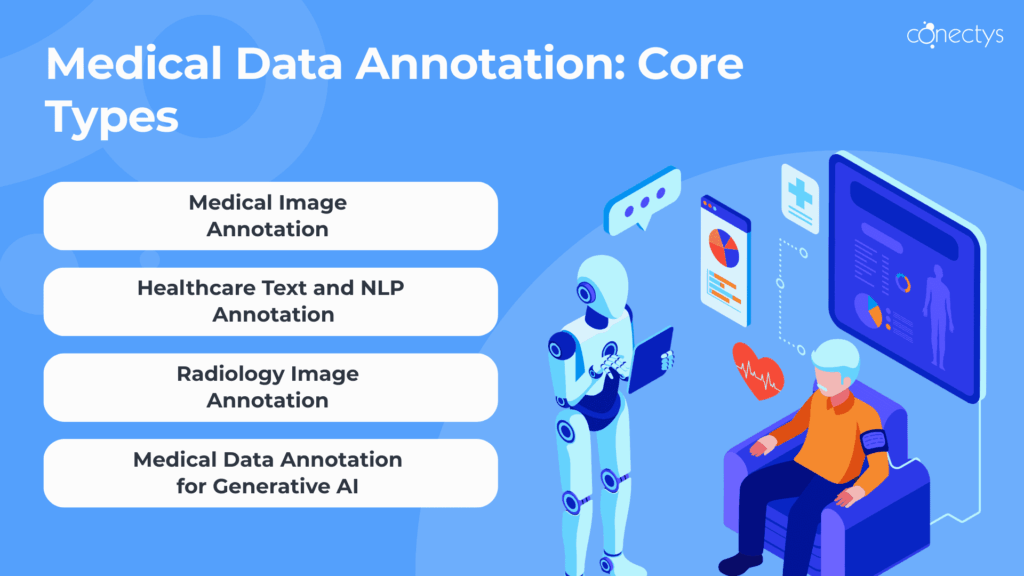
1. Medical Image Annotation
Medical image annotation is the foundation of computer‑vision models in healthcare. It powers use cases spanning tumour detection, organ segmentation, and surgical planning across CT, MRI, ultrasound, dermoscopy, fundus images, and pathology slides.
Common techniques include bounding boxes (marking nodules, fractures, lesions), segmentation masks (labelling every pixel of a structure or pathology), and landmark or keypoint annotation (tagging anatomical reference points).
High‑quality medical image annotation enables models not only to detect abnormalities but also to locate, measure, and track them over time. It is a genuinely useful tool for diagnostics, treatment planning, and longitudinal follow‑up.
2. Healthcare Text and NLP Annotation
A large share of clinical insight lives in text: EHR free‑text fields, clinical notes, discharge summaries, pathology reports, and radiology narratives. Medical text data annotation converts this unstructured content into structured signals for NLP models.
Core techniques include named entity recognition (diseases, symptoms, medications, procedures, lab values), relation extraction (linking drugs to adverse events, findings to diagnoses), and coding annotation (mapping to ICD, SNOMED CT, CPT).
Robust medical text data annotation underpins algorithms that summarise notes, surface key risks, automate coding, and build more complete patient profiles, while strong access controls and de-identification safeguard sensitive information.
3. Radiology Image Annotation
Radiology image annotation focuses specifically on CT, MRI, X‑ray, PET, and related studies. Here, radiologist‑validated labels are essential: a single missed finding or ambiguous label can erode model accuracy and clinical trust.

Radiologists and trained annotators mark findings such as lung nodules, fractures, haemorrhages, and contrast‑enhancing lesions, often with metadata on severity, location, and clinical significance.
Because this specific area sits at the centre of many diagnostic pathways, high‑quality radiology image annotation directly influences whether AI can prioritise critical cases, reduce backlogs, and support earlier disease detection.
4. Medical Data Annotation Tool for Generative AI
Healthcare data annotation for generative AI is an emerging but critical area. Generative models now power clinical chatbots, documentation assistants, decision‑support copilots, and synthetic data generators. All of them rely on carefully curated, annotated datasets.
Typical work includes building RLHF datasets where clinicians rate or correct model responses, curating prompt–response pairs with labels for correctness, tone, and safety, and validating synthetic images, notes, or EHR‑like tables to ensure they reflect real‑world distributions without exposing identities.
As these systems move into production, medical data annotation for generative AI becomes a differentiator: it decides whether models stay accurate, safe, and clinically aligned, or drift into hallucinations and regulatory risk.
How Healthcare AI Differs From General‑Purpose AI
Healthcare AI does not operate in the same world as consumer chatbots or recommendation engines. Data annotation in healthcare has to account for regulatory sensitivity, clinical nuance, and specialist knowledge: a single missed finding on a scan or a misinterpreted phrase in a note can have real‑world consequences. Ethical, legal, and safety expectations are much higher than in most other domains.
Generic annotation tools and crowdsourced platforms usually lack the clinical context, governance, and quality controls needed to handle this complexity. That is why high‑stakes healthcare AI demands medical data annotation services that are purpose‑built for regulated environments, with expert annotators, auditable processes, and bias‑aware quality checks, rather than repurposed from general‑purpose use cases.
Equally important, annotation is only one part of a broader lifecycle that includes careful study design, external validation, post‑deployment monitoring, and clear accountability for how AI outputs are used in care.
In practice, healthcare AI also runs with humans firmly in the loop. Most systems are designed as decision‑support, not decision‑makers, with clinicians retaining responsibility for diagnosis and treatment. Good annotation makes these tools more reliable, but it does not remove the need for human oversight.
When to Outsource Medical Data Annotation?
For small experiments and internal proofs of concept, it is tempting to handle healthcare data annotation with existing clinical staff or generalist data teams. That approach can work when datasets are modest, risks are low, and the goal is learning rather than deployment. But as soon as you move toward regulated, patient‑facing use cases, professional outsourcing services stop being a nice‑to‑have and, for most organisations, become the only practical way to meet clinical and regulatory expectations.
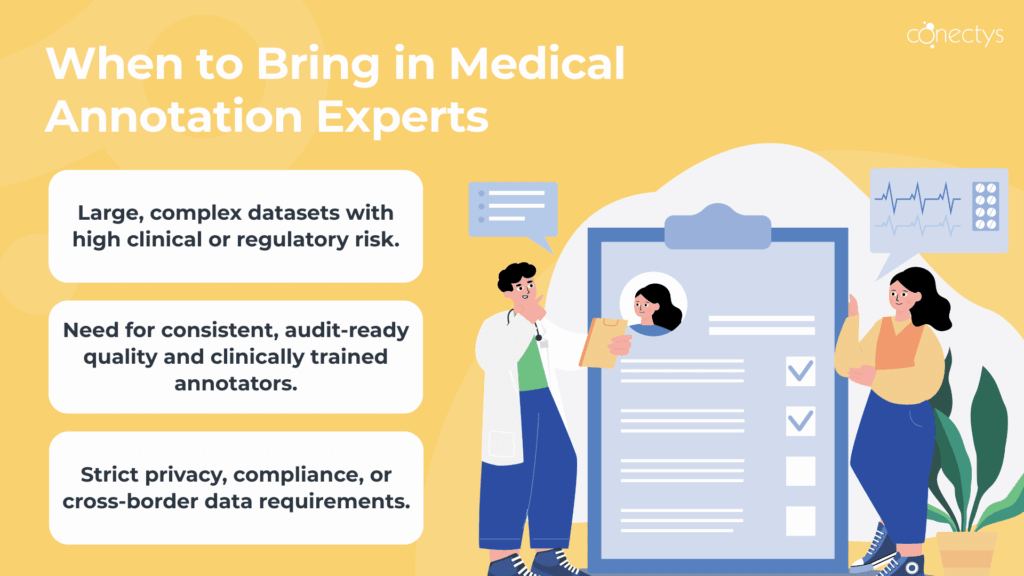
The Signal: It’s Time to Bring in Experts
Overall, you typically need professional support when three things converge: large volumes of complex medical data, high clinical or regulatory stakes, and tight timelines.
Imaging programmes that span thousands of CT or MRI studies, population‑scale EHR initiatives, or generative‑AI copilots used by frontline clinicians all fall into this category. In these situations, relying on ad‑hoc labelling is risky: it tends to generate inconsistent ground truth, untracked bias, and quality issues that only surface during validation or, worse, in production.
What Specialist Healthcare Annotation Providers Add
Specialist healthcare data annotation providers (such as Conectys) bring structured processes that most internal teams lack. They supply trained annotators (often clinicians, nurses, coders, or medically trained technicians), formal guidelines, inter‑annotator agreement metrics, and multi‑step QA workflows designed for clinical data rather than consumer images or text. That discipline is what turns “we labelled some scans” into evidence you can show to your clinical governance board, your CRO, or a regulator.
When Compliance Complexity Demands a BPO Partner
Professional support also matters when privacy and compliance complexity exceed what your in‑house team can comfortably manage. If your project touches PHI across multiple jurisdictions, involves cross‑border data flows, or is likely to underpin a SaMD submission, you need partners who live and breathe HIPAA, GDPR, and FDA‑grade documentation.

In these cases, outsourcing medical data annotation saves time and reduces legal and operational risk by integrating privacy‑by‑design and traceability into the workflow from day one.
The data annotation outsourcing market was valued at USD 1.2 billion in 2024 and is projected to reach USD 7.4 billion by 2033, growing at a CAGR of 25.5% (2026–2033). Healthcare stands out as one of its key verticals (Verified Market Reports).
Compliance and Data Security in Outsourced Medical Annotation
Healthcare organisations operate under overlapping rules: HIPAA in the US, GDPR in Europe, national health‑data laws, and, for AI‑enabled software, FDA guidance on AI/ML‑based Software as a Medical Device (SaMD). Any partner handling PHI must work inside this framework, not just sign an NDA and a BAA.
Baseline Safeguards to Expect
At a minimum, your healthcare data annotation provider should offer strong de‑identification, role‑based access, audit trails, and encryption in transit and at rest, plus GDPR‑aware processing and data‑residency options.
Due Diligence That Goes Beyond a Checkbox
Ask to see concrete evidence: de‑identification procedures, incident‑response plans, privacy impact assessments, and independent certifications such as SOC 2 or ISO 27001, along with how staff are vetted and trained.
When SaMD Raises the Bar
If your AI product is, or may become, SaMD, you also need full lifecycle documentation for datasets, labelling processes, and performance monitoring. Your annotation partner should be able to deliver this as part of your quality system, not just as extra hands.
What Good Medical Data Annotation Actually Looks Like
When you strip away the buzzwords, “good” medical data annotation is surprisingly concrete. It’s what you get when every case is labelled the same way by different people, for the same clinical reasons, and you can prove it with numbers, not just promises.
Clear Guidelines, Consistent Labels
From the outside, most medical data annotation vendors sound similar. The real difference is whether they have clear, clinically grounded guidelines and can show that multiple annotators apply them consistently. Good providers back this up with inter‑annotator agreement metrics (for example, kappa for labels or Dice/IoU for segmentations) and a plan for resolving disagreements, not just a single “accuracy” number.
QA and Specialist Involvement
Quality annotation also depends on a layered QA workflow: dual labelling in some cases, random and risk‑based audits, and extra review for tricky edge cases. Strong teams maintain an error taxonomy and use it to refine guidelines and coaching. For high‑stakes tasks, you should see a specialist‑heavy setup (radiologists, clinicians, coders) supported by trained generalists, not the other way around.
5 Questions to Pressure‑Test an Annotation Partner
| Question | What to Listen For |
|---|---|
| How do you measure inter‑annotator agreement, and what targets do you use? | Named metrics and clear target ranges. |
| What does your QA workflow look like, and who signs off? | Defined steps and accountable roles. |
| Who are your specialists vs generalists, and how are they trained? | Role split and proof of training. |
| How do you version and update annotation guidelines? | Version control and documented changes. |
| Which compliance and security certifications do you hold? | Specific standards and current evidence. |
If a BPO provider can answer these questions with concrete examples, numbers, and artefacts, not just assurances, you’re much closer to finding a partner who can truly support safe, scalable healthcare AI.
Conclusion
To sum up, strong medical AI doesn’t start with algorithms. It starts with the quality of the labels you are willing to stake real clinical decisions on. When healthcare data annotation is precise, governed, and clinically aligned, it turns noisy records into a reliable signal and compresses AI development cycles.
The wrong approach, by contrast, bakes bias, blind spots, and rework into your roadmap, where they surface later as safety concerns, regulatory friction, and lost credibility. The right annotation partner is often the only practical way to reach and sustain that standard at scale, turning a risky cost centre into a repeatable capability.
In the end, better labels and the experts who help you create them are what separate AI that quietly raises risk from AI that protects patients, budgets, and reputations.

FAQ
What is medical data annotation, and why does it matter for AI?
Medical data annotation is the process of adding precise labels, context, and structure to clinical data so AI can correctly interpret images, notes, and signals in real‑world care settings. It matters because safer, less biased models depend more on high‑quality annotations than on any single algorithm.
What types of data are annotated in healthcare AI projects?
Typical medical data annotation projects cover medical image annotation (CT, MRI, X‑ray, ultrasound), radiology image annotation, EHR text and reports, sensor data from wearables, and sometimes outcomes such as complications or readmissions. Together, these sources create the training signal AI needs across diagnosis, risk prediction, and workflow automation.
How do you ensure HIPAA compliance when outsourcing annotation?
Medical data annotation services should provide strong de‑identification, role‑based access, encryption, and detailed audit trails as a baseline. For HIPAA and GDPR, look for clear data‑processing agreements, data‑residency options, and independent certifications such as SOC 2 or ISO 27001.
What is the difference between medical image annotation and radiology image annotation?
Medical image annotation is a broad category that spans many modalities and specialities, from dermatology photos to pathology slides. Radiology image annotation focuses specifically on CT, MRI, X‑ray, PET, and similar studies, usually requiring radiologist‑validated labels and richer metadata on findings, severity, and location.
How much does medical data annotation cost?
Costs depend on data volume, modality, complexity, and the amount of specialist clinical time required. As guidelines deepen and QA steps like double‑reading or expert review are added, investment rises, helping dramatically reduce failed pilots and retraining cycles and improving overall AI ROI.