
When your team planned customer support for peak season, which forecast did it start with: the number of parcels you expect to move, or the number you expect to go wrong?
Most logistics customer service plans start with the first. ShipMatrix expects U.S. carriers to deliver about 2.4 billion parcels this holiday peak season, a 4% increase and the highest peak volume since 2022, FreightWaves reports.
However, parcel volume only tells part of the story. The pressure on customer service comes from delivery exceptions. At 2.4 billion parcels, every 1% that hits an exception is roughly 24 million parcels that may need an investigation, a customer update, rerouting, or a refund.
This article is for customer service leaders at carriers, third-party logistics (3PL) providers, and last-mile delivery companies, as well as retail CX teams answering customer questions about the same shipments. We’ll explore how to forecast exception-driven demand, use automation to resolve routine issues faster, and build flexible support capacity for the rest of this peak season and the next.
At a glance
- Forecast support demand by exception type, using your own contacts-per-exception data to see where customer service demand will build.
- Connect the shipper and recipient experience by treating contacts from both as one case and giving shippers the same status data you give recipients.
- Resolve issues before they become inquiries by notifying customers proactively, letting automation answer from live tracking data, and routing claims, damage reports, disputed delivery attempts, and repeat contacts to agents equipped to act.
- Build a layered staffing model, with a core team for claims and complex investigations and trained flexible capacity for rule-based exceptions during peak periods, each with the system access and authority to resolve cases.
- Extend capacity beyond the holiday rush by keeping support coverage through January, and measure peak season performance by contacts per exception.
Why parcel volume is the wrong number for peak support planning
In logistics customer service, the contacts that take the most work come from parcels that go wrong. During peak season, exceptions can increase faster than parcel volume, generate multiple customer contacts, and require network data and operational expertise to resolve. That’s why the support workload can quickly outpace the original volume forecast.
Even strong delivery performance leaves a large number of shipments that need attention. In the 2025 peak season, the largest U.S. carriers met their on-time delivery standards between 94.1% and 97.2% of the time, according to ShipMatrix data reported by FreightWaves. ShipMatrix’s method also leaves out some weather- and shipper-caused delays and allows an extra day for ground delivery during peak season. Across billions of shipments, even a small percentage of late parcels represents a very large number of potential customer service interactions. And late delivery is only one type of exception.
Three things push support demand beyond what parcel volume alone can predict:
- Exceptions per parcel increase. As networks run close to capacity, weather conditions change, delivery cut-offs tighten, and seasonal staff learn new routes and processes, the likelihood of shipment disruptions can rise.
- Contacts per exception multiply. Both recipients and shippers may contact customer service about the same shipment. When tracking information doesn’t change, customers are more likely to follow up with another inquiry.
- Effort per contact increases. Many exceptions require more than a status update. Agents may need to investigate a shipment, coordinate with network operations, or decide whether to redeliver, reroute, refund, or open a claim.
Here’s an illustrative example. A parcel misses its delivery date in mid-December. With no change in tracking information, the recipient opens a chat with the carrier. The retailer receives an email from the same customer and raises a separate ticket with the carrier. Two days later, the recipient contacts support again. When the parcel finally arrives damaged, the issue becomes a claim. That’s four contacts across three teams, from a single exception.
Forecasts built on a contacts-per-parcel ratio assume support demand will rise in proportion to shipment volume. As a result, companies may add agents in step with volume, then run short in the queues that need the most skill. Retailers face a version of the same problem, covered in our guide to holiday ecommerce customer service. For customer service in the logistics industry, the delivery exception is the unit to plan peak support around.
What a delivery exception means for customer service
A delivery exception, also called a shipment exception, is any event that stops a parcel moving through the delivery network as planned. For logistics customer service teams, the type of exception matters, because each type creates a different pattern of customer contact, requires a different level of effort, and may need a different team to resolve it.
Group exceptions by what customer support needs to do next:
- Explain what happened. Weather delays, network disruptions, and temporary service interruptions mainly need clear communication: what happened and when the parcel will arrive.
- Take action. Failed delivery attempts, address corrections, redelivery requests, and parcels held at a pickup location may need an operational change or coordination with the delivery network.
- Investigate. Lost or damaged parcels, and shipments marked delivered but never received, need agents to review tracking events, gather evidence, coordinate with operations, and potentially open claims.
- Unblock the parcel. Customs holds, unpaid duties, and missing shipment documents need someone to clear whatever is stopping the parcel from moving.
The same exception also looks different depending on who’s asking. A recipient wants to know when the parcel will arrive, why it hasn’t moved, and what they can do about it. A shipper wants to know how many of its parcels are affected, what information to share with its customers, and whether claims or additional costs are likely. Both views belong in your customer support plan, because both create contacts and need timely, consistent information.
In the UK, 37% of people who’d recently received a parcel had a problem with their most recent delivery, according to the Citizens Advice parcel league table (November 2025). The most frequently reported issues were a driver leaving before the recipient reached the door (29%), a parcel left somewhere insecure (24%), and late deliveries (24%). Missed delivery attempts and insecure drop-offs can require operational action or an investigation, while late deliveries mainly create communication demands. Knowing the difference tells you which resources, skills, and authority each type of exception needs.
Use this exception load plan to map your own workload. For each row, add two figures from last peak season’s data: how many contacts each exception produced, and how that changed during peak season.
| Exception type | Who contacts | Usual channel | What the customer needs | Who can resolve it | Can automation own it? |
| Delay (network or weather) | Recipient, then shipper | Tracking page, chat | A date they can trust | Automation, with live data | Yes |
| Failed delivery attempt | Recipient | Chat, phone | Redelivery or pickup | Automation; agent if disputed | Mostly |
| Address problem | Recipient or shipper | Chat, email | A quick correction | Agent, or automation with checks | Partly |
| Delivered, not received | Recipient, then shipper | Phone, chat | An investigation | Core team, depot | No |
| Damaged | Recipient and shipper | Email, phone | Refund, replacement, or claim | Core team, claims | Intake only |
| Lost | Shipper, then recipient | Email, account manager | A trace and a decision | Core team, operations | No |
| Customs or documentation hold | Recipient or shipper | Email, phone | What to pay or supply | Agent with customs knowledge | Status only |
| Refused or returned to sender | Shipper | Email, portal | Confirmation, next steps | Shipper support | Status only |
Even before you add numbers, the pattern shows: the exceptions that automation can close rarely take up your agents’ time.
Logistics has two front doors: the recipient and the shipper
A single delivery exception can trigger contacts with two separate support teams. The recipient contacts the carrier for an update and also asks the shipper (usually the retailer or brand) the familiar question: “Where is my order?” (WISMO). The shipper then raises its own inquiry with the carrier. What began as one shipment issue can quickly become multiple cases across different systems and channels.
Treating these interactions as one connected case, and giving shippers access to the same status information as recipients, reduces duplicated work for logistics customer support teams and their retail partners.
Shippers press hard during peak season because late deliveries cost them customers. Narvar’s 2025 State of Post-Purchase report, a survey of 3,461 U.S. online shoppers, found that 86% experienced at least one delivery issue in the previous year and 74% had a late delivery. The effect on future purchases was strongest among younger consumers: 60% of 18- to 29-year-olds said they wouldn’t buy again after a late delivery, compared with 17% of Baby Boomers.
This makes the retailer’s WISMO queue an extension of the carrier’s own shipper-support workload. Account managers can spend peak season chasing single parcels, while the same parcels sit in the recipient queue under different case numbers. A few practices close the gap:
- Create one connected case. Link every contact about a parcel to one case, regardless of who starts it and which channel they use.
- Give shippers visibility. Share exception codes and shipment status in plain language, so shipper support agents can answer without raising a separate ticket.
- Define who communicates. Agree who updates the recipient, what information they provide, and when each exception type requires an update.
- Send bulk exception updates. Notify shippers about groups of affected shipments, so they can respond proactively and avoid raising a ticket for every parcel.
Retail customer service teams can apply the same approach. When agents can see accurate carrier exception statuses, they can answer the first WISMO inquiry with useful information. Our page on customer service for retail brands covers how retail teams handle this part of the customer experience.
What automation should own, and when a person must take over
Automation is most effective when it handles predictable interactions using accurate, real-time shipment data. It can answer questions about parcel status, provide revised delivery estimates, and support straightforward redelivery or pickup changes. More complex situations, including claims, damage reports, repeat contacts, and disputed delivery attempts, need a trained agent with the information and authority to act.
Start with the proactive notification. A good notification reduces WISMO calls and other avoidable contacts by answering the question before the customer asks it. It explains what happened, gives an updated delivery estimate, outlines the next steps available, and tells the recipient how to get help, through the customer’s preferred channel.
In Narvar’s survey, 38% of consumers said frequent tracking updates reduce their anxiety, and nearly half preferred SMS, push notifications, or WhatsApp for urgent updates. A generic exception status with no explanation or next step does little to reassure customers and often creates another inquiry.
Behind the notification, automation can handle other routine tasks. Within agreed operational rules, it can support address corrections, make simple delivery changes, and summarize previous customer interactions, so the next agent has the context to resolve the issue without asking the customer to repeat themselves.
Handover rules matter as much as the automation itself, because resolution is where customer support often breaks down. Among UK recipients who had a delivery problem, 47% ran into a further issue trying to resolve it, Citizens Advice found, including slow responses, repeated contacts, and problems with automated systems such as chatbots.
To avoid adding friction, define escalation rules before you deploy or optimize automated support. Transfer the conversation to a trained person when:
- a parcel is marked delivered but never arrived, or is damaged or lost
- a customer contacts support for the second or third time about the same shipment
- a customer disputes a failed delivery attempt or a customs charge
- the shipment contains high-value, perishable, medical, or time-critical goods
- the customer is vulnerable, distressed, or needs accessibility support
- legal action, a regulator, or the media is mentioned
The same distinction applies when you measure performance. Evaluate the bot on accurate resolutions and appropriate human handovers. A deflection target alone can reward automation for holding on to conversations a person should handle. Our page on AI-assisted customer support explains how to divide the work between automation and agents.
Staff the exception desk, not just the phones
A peak-season workforce plan should reflect the types of delivery exceptions your operation expects to handle. When you organize support around exception types and forecast the workload each one creates, you can put the right skills and resources where they’re needed.
A practical approach is to structure the exception desk in four layers, each with its own demand drivers:
- Notifications and automation. This layer handles routine status inquiries, revised delivery estimates, proactive notifications, and straightforward redelivery or rebooking requests, so predictable interactions are resolved quickly and don’t reach live agents unnecessarily.
- Flexible peak capacity. A trained, scalable layer manages seasonal increases in redelivery requests, address corrections, and delay inquiries. These agents need the systems, knowledge, and decision-making authority to resolve routine exceptions without unnecessary escalation.
- Core resolution team. A specialized team with deeper knowledge of the delivery network handles claims, damaged or lost parcels, delivered-but-not-received disputes, repeat contacts, and shipper escalations.
- Operations liaison. Clear coordination with depots, delivery partners, customs brokers, and other operational teams connects customer service with the people who can investigate shipment issues, confirm operational changes, and move stalled parcels toward resolution.
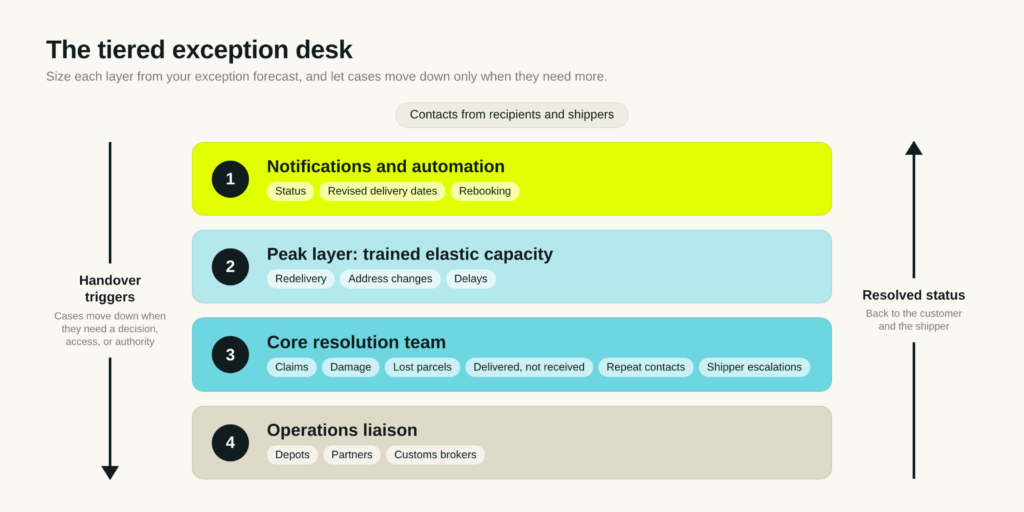
Each layer’s effectiveness depends on more than staffing levels. Agents who resolve exceptions need tracking history, depot notes, and photo proof of delivery within their workflow, so they don’t have to search multiple systems or chase other teams for answers.
Agree decision-making limits before peak season begins. Agents need clear guidelines on the refunds they can authorize, when they can arrange a replacement shipment, and which claims they can approve without additional sign-off. With those rules set in advance, teams can resolve more exceptions at first contact and avoid unnecessary escalations.
Keep training for flexible peak teams narrow. Focus on two or three common exception types, with clear escalation rules for everything outside that scope, so agents become productive sooner without having to learn the entire operation. Complete training before the first peak week, so agents are ready to handle live exceptions from day one. For cross-border operations, plan additional language coverage for customs inquiries, documentation requirements, and customers in different markets.
Peak in logistics is a few weeks when the queue changes shape. It’s very difficult to find a provider who will take on a two-week spike of extra agents, so companies either hire for the whole year or stretch the team they have. What you want is trained people for the weeks you need them, and then you step back.
Elastic capacity for peak weeks also raises a commercial question, particularly for logistics companies that outsource part of their customer service. If an outsourcing provider is paid mainly by contact volume, more customer inquiries mean higher costs, even when the underlying exception could have been resolved more efficiently.
Check whether your outsourcing agreement rewards fewer contacts per exception and better resolution outcomes. Outcome-based models can tie fees to measures such as resolution, repeat-contact rates, and time to resolve, once clear baselines and measurement criteria are agreed, as our article on outcome-based outsourcing models explains.
Peak ends in January: plan for the tail and measure what matters
The work doesn’t stop when the last peak-season parcel is delivered. Claims, investigations, returns, and late resolutions can run well into January, and every return is itself a parcel that may generate customer contacts. Keep enough support capacity beyond the holiday rush, then use exception-based performance data to build a more accurate plan for the next peak season.
It’s tempting to release flexible capacity as soon as parcel volumes begin to fall. But claims windows may still be open, investigations are still running, and shippers are reconciling their accounts. Releasing too much capacity too early leaves the core team to absorb the remaining workload, often just as employees begin taking post-holiday leave.
Instead, phase out flexible capacity gradually, using the volume and complexity of open claims, investigations, and unresolved exceptions to set the pace. That gives teams the coverage to close outstanding cases without carrying unnecessary staffing costs into the new year.
When you review peak season performance, look beyond traditional service levels to the measures that show how well exceptions were managed:
- exceptions per 1,000 parcels, by type, to see which delivery problems created the most operational pressure
- contacts per exception, to see how many customer interactions each underlying issue generated
- repeat-contact rate, to see how often customers had to follow up before reaching a resolution
- proactive notification rate, the share of exceptions you communicated before the customer got in touch
- time to resolution, by exception type, to find where investigations, coordination, or approvals caused delays
- correct automation handover rate, to check whether automated systems recognized when a person was needed
- claim cycle time, to track how long it takes to investigate and close shipment claims
- CSAT by exception type, to see how different delivery problems affect customer satisfaction
Start with contacts per exception. If it increases during peak season while the exception rate stays flat, the issue may lie in customer notifications, case management, or handovers. If both increase, the delivery network deserves as much attention as the customer service plan.
Share the findings with operations. A route, depot, delivery partner, or shipper account with an unusually high exception rate is an operational issue that needs investigation, and customer contact data can give an early warning of where those problems are developing.
How Conectys supports logistics customer service at peak
Conectys is a Business Transformation Outsourcing (BTO) partner, helping logistics companies with the operating model behind customer support as well as day-to-day delivery. That starts with understanding the exception workload: which shipment issues generate the most contacts, where automation can resolve routine inquiries, and where trained agents need system access and authority to act.
Our approach is “automation for speed, and humans for judgment.” AI supports routine status questions and gives agents the context they need for more complex interactions, while people remain accountable for claims, disputes, and decisions that need investigation or operational coordination. Through our customer experience management services, voice, chat, email, social media, and messaging are connected and consistent, which matters when a single delivery exception generates contacts across several channels.
For peak periods, our elastic workforce lets you “handle launches, seasonal peaks, or unexpected demand without long recruitment cycles.” Agents are matched through our Kboo platform and complete structured onboarding for the work they’ll handle, alongside a core team with deeper operational knowledge. We support more than 100 languages for text interactions and 70+ for speech-to-speech, from 15 locations worldwide.
We also offer outcome-based commercial models. Once baselines and measurement criteria are agreed, our incentives align with better resolution outcomes and fewer contacts per exception.
Start with last peak’s exceptions
Pull a sample of last peak season’s customer contacts and tag each one by exception type. Then add your actual contacts-per-exception figures to the matching rows of your exception load plan.
That single table shows where earlier notifications could prevent inquiries, which interactions suit automation, and where extra support capacity will have the greatest impact. Share it with operations and your largest shippers, too, since some of the most effective improvements will happen outside customer service.
It also answers the question this article started with. Next peak season, build your support plan around the parcels most likely to go wrong.