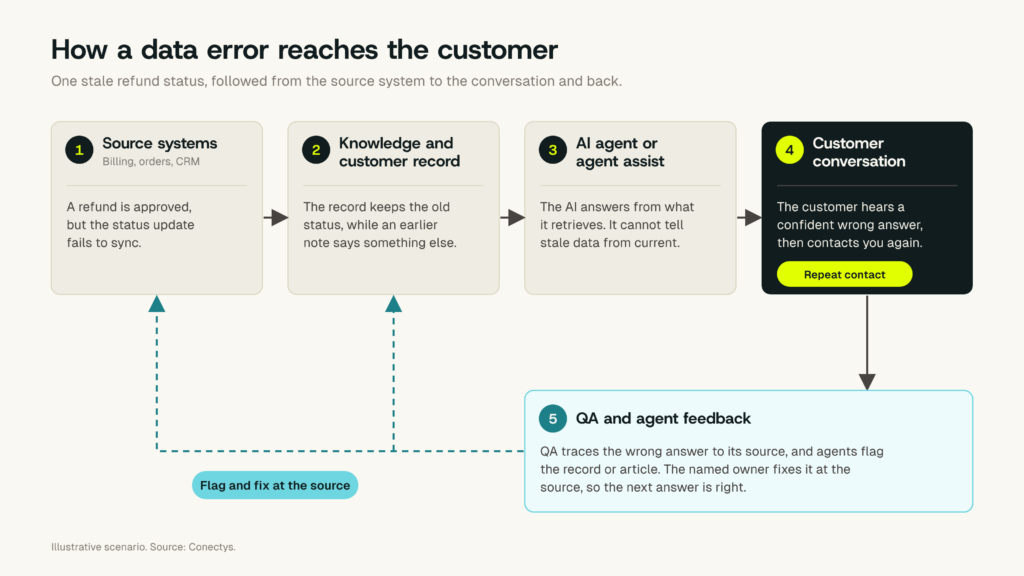
Picture a chatbot telling a customer her refund has been processed. Three days later she calls, and the agent finds it still pending in billing, next to an old CRM note that says something else. Now she has three answers and trusts none of them.
Nothing technically broke. The bot answered from the data it could find, and that’s what poor data quality looks like once AI starts answering your customers.
Before AI, a good agent might have caught the stale record. Now the same error arrives sounding certain. It surfaces as repeat contacts, longer calls, and trust that is slow to rebuild. That makes data quality a CX KPI, and it belongs on the dashboard next to CSAT and first contact resolution.
This article is for CX leaders running or planning AI in customer service. It traces where bad data enters a support operation and what it costs, then sets out the data quality KPIs that catch it, so you can decide what to fix and who owns it.
At a glance
- Treat every record your AI draws on as customer-facing. One stale record becomes a wrong answer in every conversation that uses it.
- Start with operational data: knowledge articles, customer records, order and billing status, contact reasons, and case notes. Your own agents create much of it every day.
- Track a small set of data quality KPIs tied to customer outcomes, such as top articles past their review date or wrong answers traced back to source data.
- Set a staleness tolerance for each data type. Billing status should be minutes old; a returns policy can be reviewed monthly.
- Give every data asset a named owner, and route what QA finds back to that owner with an agreed time to fix it.
Why poor data quality is now a CX problem, not only an IT one
Poor data quality becomes a CX problem as soon as AI agents and chatbots answer customers from that data. The AI grounds each reply in whatever knowledge and records it can retrieve, with no way of knowing that a policy changed last week or a status never synced.
In many companies, data quality sits with IT or a data team. They measure what happens inside the systems, such as failed syncs and duplicate records. Those checks matter, but they stop at the system boundary. A wrong record turns into a wrong answer in the contact center, and that’s where the cost lands. The exposure grows as teams move toward agentic AI in customer service, where the AI also acts on orders and accounts.
Gartner predicts that through 2026, organizations will abandon 60% of AI projects unsupported by AI-ready data. The projects that do go live carry the same weakness in a quieter form: answers that sound right and aren’t.
Air Canada found out in 2024 who owns those answers. Its website chatbot told a customer he could apply for a bereavement fare retroactively, while the airline’s own bereavement travel page said otherwise. He flew at full fare and then sought the difference. Air Canada argued that the chatbot was a separate entity. British Columbia’s Civil Resolution Tribunal disagreed: the chatbot was part of the airline’s website, and Air Canada had not taken reasonable care to make sure it was accurate.
Two of the company’s own sources disagreed, and the customer got the wrong one. Whether a wrong answer comes from conflicting content, a stale record, or a model filling a gap, the company owns it. So the practical question for a CX leader is where in the operation that data goes wrong.
Where bad data enters a customer operation
Most of the data behind customer service AI is operational, and the support operation creates or maintains much of it. It sits in four places.
The first is the knowledge base. When a policy changes and the article doesn’t, every channel repeats the old rule. In a 2024 Gartner survey, 61% of customer service leaders reported a backlog of knowledge articles to edit, and more than a third had no formal process for revising outdated ones. Translation adds another gap: a local version that lags the master gives customers in one market a different answer from customers in the next.
Customer records come next, and CRM data quality decides whether a customer has to explain everything again. Duplicates split one person’s history across two profiles; missing fields leave the AI guessing who it’s talking to.
Then there’s status data on orders and billing. This data comes from systems the support team does not own but still answers for, so freshness is the main risk.
The fourth source is the easiest to overlook: the data agents create in every contact. Contact-reason codes, case notes, and AI summaries feed both reporting and the next conversation. If one team tags an issue “return” and another tags it “exchange,” the analytics point improvement work at the wrong problem. A rushed note means the next agent, or the AI, starts with half the story.
What bad data costs: repeat contacts, misfired personalization, and trust
The cost of bad data quality shows up in the metrics CX teams already report, usually long before anyone traces it back to the data.
When a customer gets the wrong answer, they come back, and the second conversation takes longer because the agent has to work out what went wrong before fixing anything. First contact resolution drops and handle time rises, so the usual contact center metrics point at agent performance. Customers notice the repetition too: Zendesk’s CX Trends 2026 research found that 74% of consumers are frustrated when they have to repeat information.
Personalization can make things worse. In the same research, 67% of consumers said they expect brands to tailor support based on prior interactions. That expectation cuts both ways. Offer an upgrade on the product a customer returned last week, and the message they hear is that nobody is paying attention. Often, a generic reply would have done less damage.
Trust is the slowest cost to recover and the hardest to see in any single metric. A customer who has caught an AI agent being wrong may start asking for a human, or stop asking at all. Zendesk also found that 95% of consumers expect an explanation for AI-made decisions. When the decision rests on a stale record, there’s no credible explanation to give.
None of these costs points directly at the data, which is why the data needs measures of its own.
The data quality KPIs a CX operation should track
To measure data quality in a CX operation, track a short list of KPIs, each tied to a customer outcome, with a named owner and a review cadence. Start with the data behind the five to ten contact reasons that drive most of your volume.
Data teams describe quality in dimensions such as accuracy and timeliness. A CX operation needs those dimensions as things it can count: wrong answers that QA traces back to a source, or the age of a status at the moment the AI uses it.
The scorecard below maps each data asset to what the customer sees when it fails and the KPI that catches it.
| Data asset | What goes wrong | What the customer experiences | KPI that catches it | Owner | Cadence |
| Knowledge articles and policies | Outdated or conflicting content | A wrong policy answer | Share of top-volume articles past review date; wrong answers traced to an article | Knowledge manager | Monthly and on policy change |
| CRM customer record | Duplicates or missing fields | Repeating their details | Duplicate rate; completeness of required fields | CRM owner, with agents as editors | Weekly sample |
| Order and billing status | Sync delays | Told something is done when it isn’t | Sync lag against the staleness tolerance | IT or system owner | Real-time monitoring |
| Contact-reason codes | Inconsistent tagging | Misrouted contacts and slower fixes | Tagging consistency in QA samples | Operations or QA lead | Weekly |
| Case notes and AI summaries | Incomplete or inaccurate notes | Re-explaining after a transfer | Summary accuracy in QA; repeat contacts on the same case | Team leads and QA | Weekly |
| Translated content | Local versions lag the master | Different answers in different markets | Share of localized articles matching the current master | Localization owner | On every master change |
The owner column matters most, simply because a KPI nobody owns is a number nobody fixes.
Across every row, add two measures: time to detect a data problem and time to fix it at the source. They show whether QA findings and frontline flags reach the data owners, and whether those owners act.
Decide how old each type of data can be
Freshness needs its own rule: the oldest each type of data can be and still be used. Billing and order status should be minutes old; a returns policy can be reviewed monthly, provided any policy change triggers an immediate update. Had the chatbot in the opening example checked the age of the refund status, it could have handed the customer to an agent instead of confirming a refund that hadn’t happened.
Who owns data quality when AI and outsourcing partners are involved
Each data asset needs a named owner, but the CX operation should own the measurement because it sees the impact first.
Ownership follows the scorecard. IT owns the systems that hold billing and order data. The CX team owns the knowledge base and the standards for codes and case notes. If an outsourcing partner runs part of the operation, its agents create much of the contact data, so the contract should make the partner accountable for it, with a fast route to escalate what it can’t fix.
QA is where these responsibilities meet. Beyond checking whether an answer was right, reviewers should trace where a wrong answer came from and send it to the owner with an agreed time to fix. Coverage matters: a wrong answer that repeats a few times a week is easy to miss in a small sample. As AI in the contact center handles more conversations, the review has to cover those too, and when the AI can’t confirm a record is current, it should hand off to a person.
The CX team can’t repair upstream systems alone, so the scorecard routes each problem to someone who can.
“AI is an amplifier. Put it on good processes and good data, and your team can do things it couldn’t do before. Put it on bad data, and it breaks faster, in front of more customers. That’s why you never let an AI process run by itself. Someone has to check what it’s saying and what it’s drawing on.”
How Conectys approaches data quality in AI-assisted support
Conectys is a Business Transformation Outsourcing (BTO) partner, so the first question is what a process should become, and only then where AI fits. For data quality, that work starts before anything goes live. Our tech advisory practice helps clients connect the knowledge layer, covering CRM, workflow tools, and knowledge base management, and decide where AI should lead and where humans stay involved.
Once the operation is running, the focus shifts to operating and improving it. Real-time reporting, QA, and governance are built into every workflow, alongside AI-assisted agent support and quality monitoring. The model is human-in-the-loop by design, so supervisors decide what to change, whether that’s how an agent is coached or which record or article needs fixing at the source.
Conectys also holds ISO/IEC 42001 certification for responsible AI governance, issued to our headquarters in Bucharest.
AI supports the agents throughout, while people stay accountable for the answers and for the data behind them.
Start with the data behind your busiest contact reasons
You don’t need a company-wide data program to begin. Pick the five to ten contact reasons that drive most of your volume and, for each one, write down the data the answer depends on: the article, the record, the status, the code. Put an owner’s name next to each, and decide how old that data can be before it stops being safe to use.
Then make the AI decision one contact reason at a time. Where the data is current and owned, let AI answer. Where it isn’t yet, keep a person in the loop until it is. Report the data quality scorecard alongside CSAT and first contact resolution, and the next time those numbers move, you’ll know whether to look at the team or at the data.