

Most complaints about packaged products land with the retailer. A 2024 CCMC study of 8,500 consumers found that 25% of consumers complain, and 75% of those go back to the retailer. If you run FMCG customer care, or CPG customer service as US teams usually call it, that changes what your job is.
What still reaches you is mostly about the product itself. Someone wants to know whether the new recipe contains sesame. Someone’s cashback code was rejected, even though the store took their money. Someone’s dog won’t touch the new recipe. Someone has a rash after using your new serum, or has found something in a bag of chips. Few of these messages come with an order number, because you never took the order.
A retailer’s service operation is built around transactions. Yours follows your own launches, promotions, and product issues, and retail peak plans and order-status chatbots weren’t designed for that.
If you’re setting 2027 plans, this article covers what each of those events does to your contact mix, which contacts AI should never close, and how to plan capacity and contracts around your own calendar.
At a glance
- Most of your contacts arrive without an order number, so build cases around the product: batch or lot code, market, retailer, and proof of purchase.
- Launches create questions before your knowledge base is ready. Publish approved answers for each market before launch day.
- A promotion is your promise, made at someone else’s checkout. Decide in advance who owns codes and disputes, including the questions that keep coming after the closing date.
- Before a chatbot goes live, define when it hands over and what evidence your agents must capture. A small share of contacts carries safety and regulatory risk.
- Plan capacity around your own calendar, and check that your support contract rewards fewer avoidable contacts.
What makes CPG customer service different from retail CX
A retailer’s customer service revolves around the order. You usually don’t own the order, but you own the product, so your customers ask what’s in it, whether it’s safe for them, and what to do when something goes wrong.
Your agents need different information on screen, and your cases end up with different teams. Here’s how CPG customer experience compares with a retail customer service model:
| Retail CX | Your consumer care | |
| Who owns the transaction | The retailer | Usually a retailer, marketplace, or distributor. You, only for direct-to-consumer sales |
| What drives contact volume | The shopping calendar: sales events, holidays, the returns season | Your own calendar: launches, reformulations, promotions, and product issues |
| Typical questions | Where’s my order? Can I return it? When will I get my refund? | What’s in it? Is it safe for me? Has it changed? Why didn’t my code work? What should I do about this reaction? |
| What the agent needs to find the case | Order number and customer account | Product, batch or lot code, market, where it was bought, proof of purchase |
| What “resolved” means | Delivered, refunded, or replaced | Answered accurately, put right with a goodwill gesture, or escalated with complete evidence |
| Where the case goes next | Logistics, payments, the store | Quality, regulatory, R&D, legal, and sometimes the retailer |
| Regulatory exposure | Mainly consumer law on refunds and returns, plus some product-safety duties as a seller | Product-safety and adverse-event duties as the manufacturer, which can start with a single care contact |
Your retail partners handle the order. Your team gets everything the shelf can’t answer, including product questions the store passes on to you.
Launches: the questions arrive before the answers are ready
Get approved answers for each market live before launch day. Launch contacts are mostly product questions, and they peak in the first days after release, often before your knowledge base, retailer FAQs, and approved claims are in place.
A short readiness check covers four things:
- Approved answers for each market, including what changed from the last version.
- A current list of stockists by market, so “where can I buy it?” gets a real answer.
- A named contact in R&D or quality for questions the approved answers don’t cover.
- Escalation rules for anything health-related, agreed in advance.
If you sell in several markets, run the check in every language your team covers. Our guide to multilingual customer support explains how.
A reformulation counts as a launch, too. “My new bottle feels different” needs an approved answer on day one. Without one, agents improvise, and different agents improvise differently.
Demand rarely follows your plan. A product can take off on social media in one market while the launch is still weeks away in another, and the customers who can’t find it ask you.
Claims also differ by market. If an agent or a chatbot quotes another market’s version, you’ve put an unapproved claim in front of a customer.
A lot of brands look at APAC as a single region that’s similar to the ones they normally handle, but it isn’t quite the same. A product can take off in one market and struggle in the others. It may be sold through similar marketplaces and cross-border platforms, but the message and the strategy need to be adapted country by country. One size doesn’t fit all in APAC, so before adding people, I’d look for the root cause of the issue.
Promotions: the brand makes the promise, the retailer runs the till
Decide who owns codes, disputes, and goodwill before the promotion goes live. On-pack promotions, codes, and cashback offers are your promise, but the purchase happened at a retailer. When a code fails or a reward doesn’t arrive, the customer comes to you, and you have to sort it out without the transaction record.
Customers don’t know, or care, whether you, the retailer, or a promotions agency runs the mechanics. They expect the name on the pack to fix it. So settle up front who validates codes, who can approve a goodwill gesture, and whether your agents can see the agency’s fulfillment data. Code checks and status updates are good work for automation. Disputes, goodwill decisions, and suspected abuse need a person who can weigh the situation and the customer’s history.
There are rules to work within. In the UK, the CAP Code requires promoters to run promotions “equitably, promptly and efficiently,” to avoid “causing unnecessary disappointment,” and normally to award prizes within 30 days. Other markets have their own rules, so your agents need each market’s terms and the authority to apply them.
If you sell alcohol, add one more check. The same code says alcohol “must not be available on promotion to anyone under 18,” so build an age check into the promotion, and send any contact involving a minor straight to a person.
Promotion volume has its own shape. It rises at launch, rises again near the closing date, and leaves a tail of fulfillment questions for weeks afterward. In Asia-Pacific, the double-day sales (9.9, 10.10, 11.11, and 12.12) also bring gift sets, bundles, and gift recipients with no order number. Planning for retail peak season follows the shopping calendar. Promotion planning follows yours.
Product issues: the few contacts that carry most of the risk
Complaints about a reaction, an allergen, a foreign object, or an injury are a small share of your contacts, but they carry most of the risk. Each one needs a trained person, complete evidence, and a fast route to your quality and regulatory teams.
It might be a rash after a new serum, or a foreign object in a snack. It might be a swollen can, a pet that was unwell after eating, or a child who got into a cleaning product.
They’re also easy to miss. In the CCMC study cited above, 75% of consumers who complained to a manufacturer used a digital channel to do it. So a message about a reaction can sit in your queue next to 50 questions about stock, and look much like them until someone reads it properly.
These cases add up. The EU’s Safety Gate system logged 4,671 alerts for dangerous non-food products in 2025, the most ever recorded. In Australia, undeclared allergens caused 38% of the 92 food recalls that year, according to Food Standards Australia New Zealand. In the US, the PIRG Education Fund counted 320 food recalls, 48% of them caused by undeclared allergens or foreign objects.
The reporting clock can start in the care queue
For some products, a customer’s message starts a legal clock. Under the US Modernization of Cosmetics Regulation Act (MoCRA), you must report serious adverse events from cosmetics to the FDA within 15 business days of receiving them. Dietary supplements carry the same 15-business-day duty under FDA guidance, and labels in both categories must include a US contact for these reports (21 U.S.C. §364e covers cosmetics). In the EU and Great Britain, serious undesirable effects from cosmetics must be reported “without delay,” under Article 23 of Regulation (EC) 1223/2009.
The contact on your label often leads straight to your care team. If your team doesn’t recognize a serious case, or doesn’t capture enough to assess it, you can lose days you don’t have.
What agents need to capture
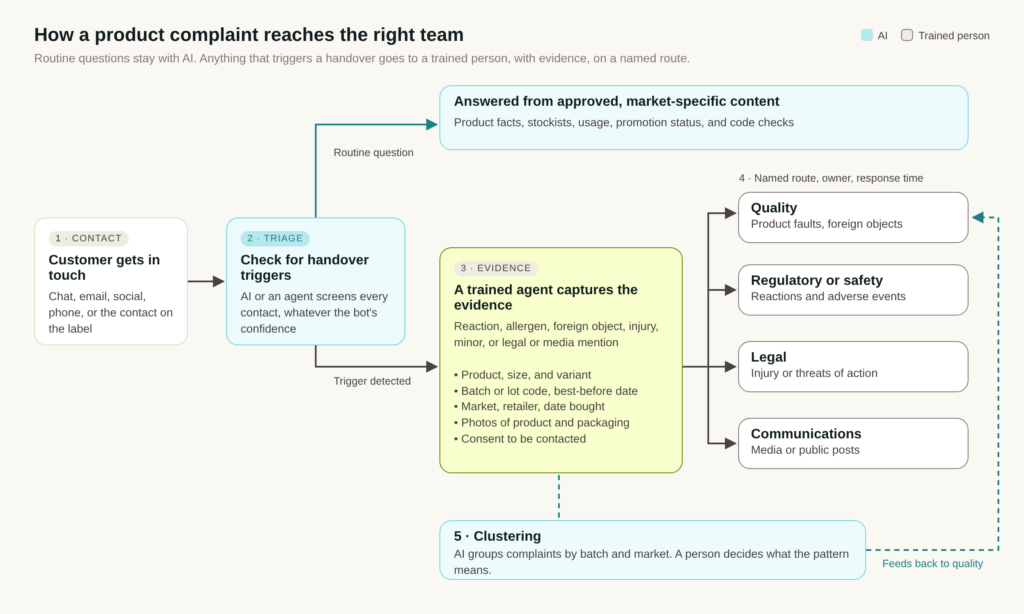
Good product complaint handling starts with a short evidence list, complete on the first contact:
- Product name, size, and variant
- Batch or lot code and expiry date, read from the pack
- Where and when it was bought, and in which market
- Photos of the product, the packaging, and any foreign object
- Whether the customer can keep or return the product
- What happened, in their words, including any medical or veterinary care, recorded only as your procedures and privacy rules allow
- Consent to be contacted by your quality or safety team
Then each case needs a named route, with an owner and an agreed response time. Product faults go to quality, reactions to regulatory or safety, injuries and legal threats to legal, and anything public to communications.
Clustering gives you early warning. When three customers in two markets describe the same problem with the same batch, AI can surface the pattern sooner than a weekly report. A person decides what it means.
The customer, meanwhile, is usually worried, sometimes about a child. They need to hear what happens next, from someone who sounds like they’ve done this before.
When a product issue becomes a recall
A recall turns your care team into a public-facing operation overnight. Volume jumps, outbound messages go out, and every script needs legal approval. Customers also need reminding. Australia’s consumer regulator, the ACCC, notes on Product Safety Australia that it “can take 4-6 times” before consumers act on a recall. It recommends giving people several ways to get in touch, and publishing a recall FAQ to cut down on similar calls.
So prepare the script and FAQ templates now. Decide how you’ll refund customers who have no receipt, and agree how you’ll work with retailers taking the same calls. Line up surge capacity you can switch on within days. Logistics, legal strategy, and crisis communications sit with other teams. Your job is to make sure everyone who gets in touch hears the same clear answer.
Where AI fits in consumer care, and where it must hand over
AI works well when it answers from your approved product information for each market and handles routine questions about availability, usage, and promotions. Any message about a reaction, an allergen, an injury, a foreign object, or a legal or media threat should go to a trained person, with the full context.
AI also helps behind the scenes. It can summarize a customer’s history before an agent picks up, group complaints by batch or market, and review far more conversations for quality than a manual sample can, with people checking its work.
The harder decision is where your bot stops. Hand the conversation to a person, whatever the bot’s confidence, when a customer:
- describes any symptom or reaction, in a person or a pet, however mild
- asks about allergens after a reaction, or on behalf of a child
- reports a foreign object, damaged packaging, or possible tampering
- asks about pregnancy, medication, or a medical condition
- suspects a counterfeit or an unauthorized seller
- mentions a minor in connection with an age-restricted product
- mentions a lawyer, a regulator, a journalist, or a public post
- is contacting you for the third time about the same issue
AI is fantastic at speed and at the amount it can handle, but it’s never going to have empathy or understand a niche situation. A customer describing a reaction to a product is a niche situation every time. Let AI deal with the routine questions, then hand over with the full context, so the agent knows exactly what they’re walking into.
This also changes how you measure the bot. Deflection rewards it for keeping conversations away from people, including the ones that should reach them. Correct resolution and correct handover are better measures. Our page on AI-assisted customer care covers how to design that split.
Build consumer care around your brand calendar
Start by mapping next year’s launches, promotions, and known risk periods. Then plan each type of event on its own terms. Launches need approved content and cover for a short peak. Promotions need a window that includes the tail after the closing date. Product issues need an escalation path and a surge plan that’s ready before you need it.
Use this matrix as your planning template.
| Launch | Promotion | Product issue | |
| What customers ask | Where to buy, ingredients, suitability, what changed | Codes, eligibility, proof of purchase, missing rewards | Reactions, allergens, foreign objects, damage, recalls |
| What breaks | Answers aren’t approved in time; markets get different versions | Nobody owns the dispute; the agency’s data isn’t visible | Serious cases look routine; evidence is incomplete; routing is unclear |
| What AI can own | Approved product facts, stockists, usage | Code checks, eligibility rules, status updates | Intake, clustering by batch or market, agent summaries |
| What goes to a person (and where next) | Health and suitability questions → R&D or regulatory | Disputes, goodwill, suspected abuse → promotions owner | Every case → quality, regulatory, legal, or communications |
| Capacity pattern | Sharp, short peak in the first days or weeks | Rise at launch and near the closing date, then a long tail | Unpredictable; a recall needs surge capacity within days |
| What to measure | Accuracy of answers, repeat contacts after launch | Time to resolve a dispute, complaints about fairness | Time to route, evidence completeness, cases reported on time |
This usually points to three layers. A core team holds the product knowledge and handles serious cases. Elastic capacity for launches and promotions covers the peaks. Language coverage follows the markets where each event lands.
Every brand is confronted with seasonality or peak moments, and a launch or a big promotion is exactly that. You don’t want to carry a full team all year for a few weeks of volume. Combining a core team with an elastic workforce lets you absorb those peaks and troughs, and bring in a specific skill or language only for as long as you need it.
Review your contract as carefully as your staffing plan. Many care contracts are priced per agent or per hour. Under that model, better launch content and fewer repeat contacts also shrink your provider’s invoice, which gives them little reason to push for either.
Per-agent pricing can still be right, especially for a new program. Once your operation is established, an outcome-based model ties the fee to results you care about, like resolution, repeat contacts after a launch, or how fast a product-safety case reaches the right team. Agree the baselines and clean up the data first. Our article on outcome-based outsourcing models explains the wider shift.
How Conectys supports FMCG consumer care
Conectys is a Business Transformation Outsourcing (BTO) partner, so we work with you on the operating model behind your care, as well as the daily delivery. That starts with the event map above: where your contacts will come from, which ones AI can answer from approved content, and which need a trained person and a route to your own quality, regulatory, and legal teams.
Our approach is “automation for speed, and humans for judgment.” AI gives agents context and handles routine answers. People stay accountable for conversations that carry safety, regulatory, or brand risk. Voice, chat, email, social, and messaging are connected, so a customer who reports a problem in one channel doesn’t have to start again in another.
Product launches and promotional peaks are part of our normal operating rhythm. Elastic capacity lets you “handle launches, seasonal peaks, or unexpected demand without long recruitment cycles,” alongside a core team that knows your products.
We also offer outcome-based commercial models. Once baselines are agreed, we benefit when your avoidable contacts fall, so better launch content and cleaner handovers count as progress for both of us.

Start with last year’s contacts
Before your 2027 calendar is locked, take a sample of last year’s contacts and tag each one as a launch, a promotion, or a product issue. Then look at how many had no approved answer, how long serious cases took to reach the right team, and how many came back.
The results will show which parts of your model were borrowed from retail and which you need to build yourself. Write your handover triggers and evidence checklist before the next launch, while there’s still time to test them. The contacts that reach you are the ones you can’t hand back to the store.