
For years, the conversation about human content moderation has run on a labor equation: the better AI gets, the fewer human moderators a platform needs. It’s simple, and part of it is true. As a way to plan complex operations, though, it leads to the wrong decisions, and Trust & Safety is one of the clearest examples.
The pressure behind it is real. Platforms are automating more of their first-pass review every year, and PwC’s Trust and Safety Outlook 2026 expects front-line moderation volume to “plateau—and eventually decline—even as platforms continue to grow.” High-volume review of clear-cut content is shrinking, and some moderation jobs are going with it.
What the labor equation misses is what happens to the decisions that remain. If you lead Trust & Safety and are deciding how to staff human review alongside AI, the more useful question is which human decisions now carry more weight, and how to design around them.
At a glance
- AI is taking over high-volume, first-pass review. Plan for fewer generalist moderators and more reviewers with depth in policy, a market, or a language.
- Keep qualified people on four kinds of decisions: policy interpretation, gray-area and high-consequence cases, appeals, and content that depends on cultural or linguistic context.
- In some areas, human review is a legal expectation. The EU Digital Services Act requires decisions on user complaints to be supervised by appropriately qualified staff, and very large platforms must report their moderators’ qualifications, languages, and training.
- Judge your expert review layer by how confidently and consistently your platform acts when the answer isn’t obvious, and by how quickly reviewers’ findings change your policies and models.
What AI moderation now does better than people, and what it can’t do alone
Some human moderation work is disappearing, mostly first-pass review of clear-cut content. Automated content moderation can screen enormous volumes, recognize known patterns, prioritize risk, and apply clearly defined rules faster than any human team.
Detection is only part of the job, though. A Trust & Safety operation also has to:
- make proportionate decisions, so the response fits the harm;
- explain those decisions to users and, increasingly, to regulators;
- apply policies consistently across markets and languages;
- correct its own errors;
- respond when new behavior falls outside what the model was trained on.
None of these is a pattern-matching problem. Each one asks someone to weigh context, impact, and policy intent, and then to stand behind the result.
In practice, the work splits by confidence and impact. Routine, high-confidence cases move through automated workflows, and uncertain or high-impact decisions go to trained reviewers (our guide to how AI content moderation works covers the mechanics). That hybrid moderation setup also concentrates the hardest work in the human queue.
The same PwC outlook sums up the shift: “Human decisions will become less frequent, but far more consequential.”
So what’s emerging isn’t machine moderation with occasional human support. It’s a governed operating model, in which automation provides reach, speed, and consistency, and expert reviewers provide interpretation, contextual judgment, accountability, and control.
Four areas where human content moderation needs expert reviewers
In my experience, human expertise creates the most value in four areas: policy interpretation, gray-area and high-consequence decisions, appeals and contextual review, and cultural and linguistic expertise. Each one depends on judgment that a confidence score can’t supply.
1. Policy interpretation applies written rules to context
A written content moderation policy doesn’t always lead to one obvious decision. Even experienced reviewers can read the same rule differently, especially when its wording leaves room for judgment. The same image may also need different decisions depending on how and why it’s shared: footage that documents harm in a news report may call for a different response when it’s posted to celebrate that harm. Different outcomes in that case can be the correct application of the same policy to different contexts.
For machine-learning systems, this creates an extra challenge. Recognizing the image solves only part of the problem, and past labels may reflect both legitimate differences in context and unresolved disagreement between reviewers. Expert reviewers help separate the two, document their reasoning, and clarify guidance through calibration, which gives both people and models a more reliable basis for future decisions.
2. Gray-area and high-consequence decisions need proportion and a rationale
Satire, reclaimed language, and political speech sit in gray areas where reasonable reviewers can disagree. Other decisions are high-consequence because of what follows: an account ban, a report to law enforcement, the removal of a journalist’s post. A confidence score measures how sure a model is about a pattern. It doesn’t measure impact or intent. These cases need someone who can choose a proportionate action and document why, because that rationale makes the decision defensible later.
3. Appeals and contextual review show what the first decision missed
When a user appeals, the reviewer looks for what the original decision didn’t see: account history, the surrounding conversation, a local event, the intent behind the post. The model that made the first call is poorly placed to judge its own error, so appeals need a qualified person who can see the full context. Appeals are also the system’s clearest source of learning, as the next section shows.
4. Cultural and linguistic expertise reads meaning that models miss
Meaning often depends on dialect, slang, local politics, or a joke that only works in one market, and trends move faster than models are retrained. The Oversight Board has pointed to the same language gap, warning that companies “must not evaluate model performance based solely on the results of English-language benchmarks.”
Some things that we would take as a joke, other cultures don’t take as a joke at all. The laws are different from market to market, and so are the cultural nuances. A model trained mostly on one market won’t see that difference. You need people who know the language and the culture to make those calls.
Together, these four areas change the profile of the people you need: fewer generalists working through volume, and more reviewers with depth in policy, a market, or a language, backed by the calibration and care that harder work demands.
How expert decisions make the whole system better
Every expert decision is also information. It shows where a policy is unclear, where a model misreads context, and where enforcement differs between markets. A governed operation feeds it back into guidelines, escalation rules, reviewer training, and the human-labeled training data that improves its models. One that doesn’t keeps paying for the same mistakes.
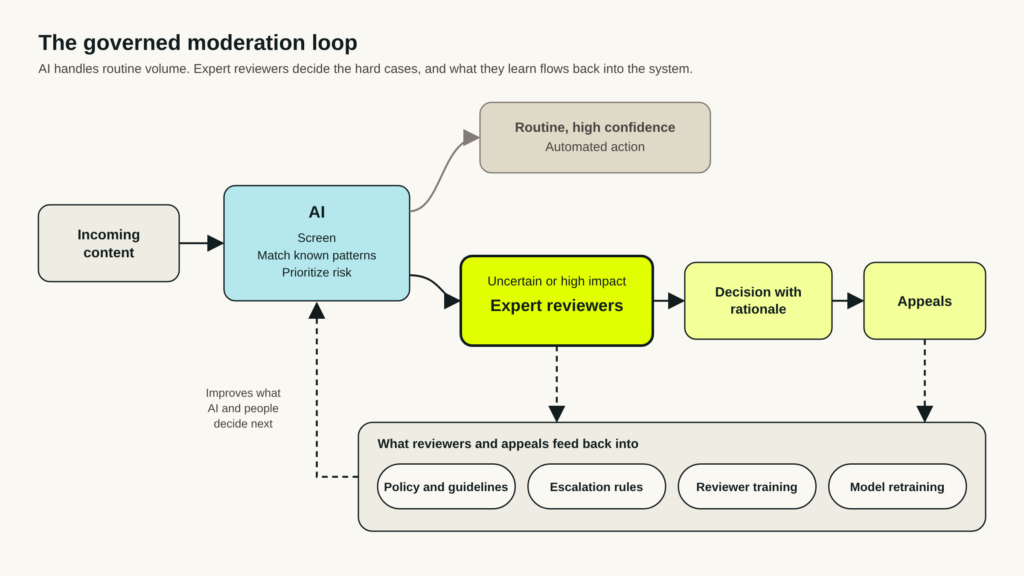
As AI takes on more routine decisions, the cases that reach people become more complex and more consequential. That changes where human expertise creates value. The opportunity is to turn those expert decisions into a continuous feedback loop that makes the entire system better.
Appeals show this most clearly. According to an Oversight Board report, Meta received more than seven million appeals against hate speech removals in February 2024. Eight in 10 people who appealed used a new option to add context. Of those, one in five said their post was meant to raise awareness, and one in three said it was a joke. Some of those explanations won’t hold up. Even so, each one flags context the original decision didn’t weigh, which is exactly what a reviewer needs to check.
Appeals can also expose errors at system scale. In its 2022 Colombian police cartoon decision, the Oversight Board described how a cartoon wrongly added to an automated matching bank kept being removed. In total, 215 users appealed, and 98% of those appeals succeeded. The Board found that such banks “can amplify the impact of incorrect decisions by individual human reviewers,” and recommended reassessing content with high rates of appeal and successful appeal. Automation scaled one human mistake, and appeals found it. (Our overview of appeals and escalation covers how these workflows run day to day.)
Where the law already expects qualified human review
In some areas, human review is more than good practice for a healthy operation. It’s a legal expectation, and regulators increasingly ask platforms to show who makes their moderation decisions and how those people are prepared.
The EU Digital Services Act is the clearest example:
- Article 16 requires hosting services to handle notices of illegal content “in a timely, diligent, non-arbitrary and objective manner,” and to tell the notifier when automated means were used.
- Article 20 requires online platforms to ensure that decisions on user complaints “are taken under the supervision of appropriately qualified staff, and not solely on the basis of automated means.”
- Article 42 requires very large online platforms to report the human resources they dedicate to content moderation, broken down by official language, along with “the qualifications and linguistic expertise” of those people and “the training and support given to such staff.”
In the UK, Ofcom’s illegal content codes under the Online Safety Act ask large and multi-risk services to resource their content moderation function and to train the people who work in it.
None of this means a person must re-read every complaint. Legal scholars Rachel Griffin and Erik Stallman argue that Article 20 works best as oversight of the whole system, with qualified staff reviewing samples of decisions and refining policy to reduce future errors. In practice, that means keeping a clear record of who your reviewers are, what they’re qualified to decide, and how they’re trained and calibrated, because that’s the evidence a regulator or auditor will ask for.
How to tell if your expert review layer is working
Measure how confidently and consistently your platform acts when the answer isn’t obvious, and how quickly what your reviewers learn changes the system. Counting the human decisions you’ve removed shows what automation saves. It says little about whether the hard calls are being made well.
These are the five measures I’d start with. None of them is an industry standard, but together they show whether the expert review layer is doing its job.
| Measure | What it tells you |
| Overturn rate on appeal, by policy area and market | Where first decisions are weakest, and whether the cause is the model, the policy, or a specific market |
| Reviewer agreement on calibration sets for gray-area queues | Whether a policy is clear enough to be applied consistently |
| Time from a new pattern to updated guidance | How fast the operation adapts to behavior the model hasn’t seen |
| Consistency of the same policy across markets and languages | Whether users in different markets get the same decision for the same content |
| Share of escalated decisions with a documented rationale | Whether high-consequence decisions can be explained to users and regulators |
Read them together and over time. An overturn rate that falls while reviewer agreement drops, for example, may mean fewer users are appealing rather than that decisions are improving. None of these measures has a universal target, and each needs a baseline. Some will look worse at first, simply because the team has started looking more closely, which is usually a sign the loop is working. Review them with the policy owners and the model team together, so that every finding has a clear owner and a route back into the system.
How Conectys builds expert review into Trust & Safety
At Conectys, we design the AI and human roles in a moderation operation together: “AI-assisted review flags risk. Humans make the important calls.”
The work starts with the platform’s risk landscape: which harms matter most, where volumes spike, which markets and languages need coverage, and which decisions carry the most consequence. From there, we tailor AI tools, human workflows, escalation paths, and QA frameworks to the platform, so routine cases move quickly and decisions that need judgment reach people qualified to make them.
Our moderation is policy-driven, with “clear policies, human judgment, and continuous calibration.” Global teams are trained to apply policies fairly across languages and cultures, and moderation runs 24/7 across time zones and content types. Once a program is live, the work continues through policy updates, trend analysis, AI integration, workflow optimization, and performance tuning. During calibration, we map edge cases by policy area, risk, and context, and add expert-validated decisions, rationales, and examples to the guidelines. Golden assessments check reviewers against reference decisions, and AI-assisted and human QA strengthen quality reviews where appropriate. We also track inter-rater reliability to monitor decision consistency, so disagreements become clearer guidance for both reviewers and models.
Harder work also needs strong support systems, rotation models, and care, because healthy teams make better decisions.

Where to start
Before your next round of automation, map the decisions in your operation that are ambiguous or high-consequence. Make sure qualified reviewers own them, with the authority to escalate and the time to document why. Then check whether what they learn reaches your policies, escalation rules, and models. If it doesn’t, close that gap first.
The real measure of progress in Trust & Safety isn’t how many human decisions AI can eliminate. It’s how confidently a platform can act when the answer isn’t obvious. Technology may narrow the field, but people give difficult decisions meaning, legitimacy, and direction. Organizations that design around that will be better prepared for today’s risks and for the ones no model has seen before.