
Picture a fashion retailer on Black Friday evening. A discount code has stopped working in two of its four European markets, the chatbot keeps quoting terms that changed that afternoon, and agents hear about the problem from customers.
The team was staffed for the volume. Its approach to holiday ecommerce customer service, though, was built for one spike.
Retail peak arrives in waves, from the first October promotions to the January returns. A team sized for Black Friday week tends to break on either side of it. Before the spike, promotions change faster than agents and the chatbot can keep up. After it, returns land just as seasonal contracts end.
If you run retail customer experience across several markets, this article shows where support breaks in each wave and who should handle it. It also covers what you can still fix before Black Friday on November 27.
At a glance
- Plan peak as four separate waves. Each brings different customer questions and puts pressure on a different part of the operation.
- Give promotion knowledge a single owner. When offers change mid-campaign, agents and chatbots often fall behind before the queue even grows.
- Agree in advance what agents can offer for late or lost parcels, such as reshipping, a partial refund, or credit, so they can settle the issue in one contact.
- Keep additional staffing in place through January. Many seasonal contracts end before the returns wave does.
- Match each type of customer question to the right kind of help: your experienced core team, an outsourcing partner, gig agents paid per completed task, or automation.
Retail peak is four waves of demand
In short: retail peak lasts about three and a half months and arrives in four waves, each with its own contacts and its own weak point.
In retail and ecommerce, customer service during the holidays runs from mid-October to the end of the January return window. Here’s what each wave brings.
- Pre-peak promotions (mid-October to mid-November): bring questions about prices and promotion eligibility. Brands selling in Asia have Singles Day on November 11.
- Black Friday week starts (November 27 into early December): contacts shift to order status, payment failures, and discount codes that won’t apply.
- Last shipping days (early to mid-December): bring late or lost parcels and anxious questions about whether gifts will arrive in time.
- January returns (Boxing Day to end of January): refunds and exchanges lead, while post-Christmas and January sales in the UK and much of Europe add fresh orders to the same queues.
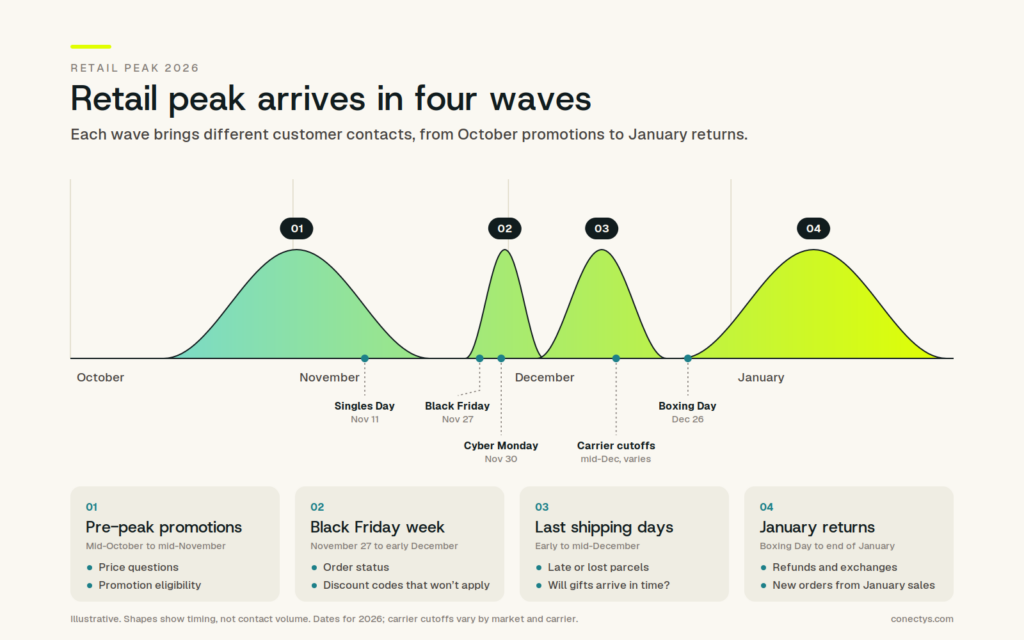
Because the waves differ in length and in what customers need, one headcount plan for the whole peak retail season fits none of them well. The 90-60-30 peak playbook covers preparation. This article focuses on what breaks and who should handle it.
Your peak plan is built for the wrong week
In our experience, many retail teams plan holiday season customer service around one number: the headcount Black Friday week needs. They build to it with seasonal staffing and overtime. The result is a team that’s under-trained for the first wave and often released before the last.
That approach works for a modest spike. When extra demand lasts a week or two, overtime and a few temporary agents can carry it, and the core team already knows the products and policies. But overtime is a patch, and retail peak lasts three and a half months.
Over that stretch, the plan comes apart in three places. New agents need time to get up to speed. That pushes their training into October and November, when experienced agents have the least time to coach them. Seasonal contracts often end at Christmas, because that’s where the hiring plan stopped. And the contact mix keeps shifting: promotion questions in early November look nothing like refund disputes in January.
The costs follow the same flaw. You pay for a team sized around one week. Extra help for the other waves comes at whatever notice period and rate your contract allows.
Retail peaks rarely fit a standard outsourcing contract. If you sell flowers and chocolates, Valentine’s Day is one of your biggest weeks, but you don’t want to carry that team for the rest of the year. Black Friday works the same way. You might need 50 more agents for 14 days, and that’s where a gig model earns its place.
What breaks, and when, depends on the wave.
Where support breaks in each wave
Each wave breaks holiday ecommerce customer service in a different place, so a fix for one rarely covers the next. These are the failure points to check first.
Pre-peak promotions: Knowledge goes stale before the queue grows
Promotions create confusion before they create volume. Offers change mid-campaign, eligibility rules collect exceptions, and price-match policies move with competitors. Often, nobody has briefed the agents or updated the chatbot by then. It’s the same failure the retailer in our opening hit on Black Friday evening: the terms had changed that afternoon, and nobody had told the bot.
A chatbot working from your knowledge base can take real volume off the queue at peak. It handles the cookie-cutter questions, though, and only while that knowledge is current. People expect it to manage complex cases after a few weeks of setup, so be pragmatic. Automate the simple contacts and keep experienced people on everything else.
A chatbot that confidently quotes last week’s offer does more damage than no chatbot at all. The safeguard is ownership. Name one person who owns promotion knowledge for the season and can push each change to agents and automation on the same day. Decide in advance where automation should stop, too, so a bot that’s unsure of the current offer hands the customer to a person instead of guessing.
Black Friday week: Simple contacts crowd out the complex ones
In Black Friday week, a few repetitive questions take over: where is my order, and why won’t this code apply? Each one is simple. Together they fill the queues, and the complex cases (a damaged high-value order, a customer charged twice) wait behind them while wait times climb.
AI agents are handling a rising number of these conversations. Salesforce reported that customer service conversations handled by AI agents on its platform were 55% higher in Cyber Week 2025 than in the week before. That only protects the operation if routing keeps complex contacts moving. Give them their own queue or priority, so surges in the simple categories don’t set the wait time for everyone else.
Last shipping days: Delivery exceptions need authority
In the last shipping days, contacts get harder. A parcel is stuck at a depot, an address needs changing after dispatch, a gift won’t arrive before the 24th. These customers are anxious, and they want someone to make a decision.
The usual failure is authority. Agents can see the problem but can’t fix it, so they transfer the contact or promise a callback, and the customer comes back. Before December, agree what agents can offer without asking a manager: express reshipping, a partial refund, or store credit, and up to what value. Pair them with a named escalation path into each carrier, so problems agents can’t solve still move the same day.
January: The peak after the peak
Returns start on Boxing Day, and many of them are our retailer’s Black Friday orders coming back. Refunds, exchanges, and gift returns arrive just as many seasonal contracts end.
In the US, the National Retail Federation and Happy Returns found that retailers expected 17% of 2025 holiday sales to be returned, and 43% planned to hire seasonal staff to handle returns. Those hires help only if their contracts run through January.
When they don’t, refunds slow down. Every refund you delay comes back as another contact, from a customer asking where their money is. Agree a refund timeline with finance and the warehouse before peak, and keep returns staffing in place until the return window closes. Otherwise, the holiday returns rush turns January customer service into a second peak.
Match each wave to the right support model
Keep high-judgment and high-value contacts with your experienced core team. Use an outsourcing partner for predictable volume in languages you already support, and gig agents paid per completed task for short spikes and backlogs. Automate only the repetitive contacts where the information is current and the route to a person is clear.
The capacity map below applies that split to each wave, plus the ramp-down after it. Read each row from left to right, from what the wave brings to the support that should take the load. The last column is the one thing to protect when everything else is stretched.
| Wave | Main customer questions | What usually breaks | Best-fit capacity | Protect |
| Pre-peak promotions (mid-October to mid-November) | Prices, promotion eligibility | Agents and the chatbot fall behind promotion changes | Core team, automation working from current knowledge, partner agents trained early | One owner for promotion knowledge |
| Black Friday week (November 27 to early December) | Order status, payment failures, discount codes | Simple volume buries complex cases | Automation for order status with a clean handoff, partner and gig agents for repetitive questions | Separate routing for complex cases |
| Last shipping days (early to mid-December) | Late or lost parcels, gift deadlines, address changes | Agents lack authority, so contacts get transferred | Experienced agents, plus partner agents working to written rules | Agreed limits on what agents can offer |
| January returns (Boxing Day to end of January) | Refunds, exchanges, gift returns | Extra agents have left, refunds lag, contacts repeat | Partner agents staying through January, gig agents paid per completed task | A refund timeline agreed with finance and the warehouse |
| After peak: ramp-down (February) | Follow-ups, complaints | Paying for agents with nothing to do | Release extra agents in stages | A record of what to change next year |
Extra staffing comes with conditions. Outsourced and gig agents need training on this season’s promotions, quality checks in each language, and system access that lets them resolve a case as well as look it up. A managed gig workforce works on the same terms.
Not every retailer needs all four. A single-market brand with a strong in-house team may only need automation for order status and an outsourcing partner for January. Start with the wave that hurt most last year.
Seven weeks out: What’s still worth fixing
With about seven weeks to go, you can’t rebuild your operating model. But you can still close the gaps behind the failures above. At this stage, ecommerce holiday customer service preparation comes down to five changes:
- Name one owner for promotion knowledge, with the authority to update agents and automation on the same day.
- Test the chatbot against this year’s promotion rules before the next campaign goes live.
- Write down what agents can offer for delivery exceptions, and up to what value.
- Move the end dates of seasonal and partner contracts to the close of your return window.
- Agree the thresholds that trigger additional support, so nobody has to negotiate it on Black Friday evening.
If you’re considering a new partner, plan around January. In our experience, onboarding a new provider takes 4 to 12 weeks, and security review, tool access, and knowledge transfer often delay launch more than hiring does. Adding agents with a partner you already use is faster, so start that conversation this month.
Conectys plans peak support wave by wave
Conectys builds peak capacity wave by wave, combining experienced CX professionals, AI, and an elastic gig workforce in one operating model. Experienced agents take complaints, escalations, and delivery exceptions that need judgment. AI handles repetitive contacts such as order status, with human oversight and a clear handoff. Multilingual Gig Talent Pools, trained on your products, add agents when a wave outgrows the plan, across the 60+ languages we support.
Returns, refunds, order, and billing support all run under the same quality checks, so January gets the same standard as November. Commercial terms flex downward: the initial term, phased ramp-up, and seasonal capacity are set in the business case, and we’re contracted for outcomes rather than seat count.
Comparing partners? Our guide to holiday customer service outsourcing covers that decision.
Start with the weeks your plan ignores
By mid-January, our retailer’s Black Friday problem has a second act. The orders that made it through the broken discount code are coming back as returns, refund questions are piling up in four markets, and the seasonal team finished on December 31.
None of it was hard to predict. Before you sign off this year’s plan, put two dates side by side: the day your seasonal agents leave, and the day your return window closes. If the first comes before the second, plan your staffing back from the later date.