
At a Glance
Peak season is when your CX either cracks or compounds your company’s growth. Demand surges, patience shrinks, and “just add more agents” stops working. Smarter forecasting, automation, and elastic capacity from outsourcing and GigCX help you stay calm in the chaos. They also turn seasonal spikes into repeatable wins. Read on to see how.
Key Points
- Peak-season customer experience compresses risk and exposes every weakness in your CX model.
- Scalable CX, built on elastic capacity, AI, and omnichannel journeys, turns seasonal spikes into predictable performance.
- Outsourcing and GigCX, used strategically, give brands the flexibility to protect quality, revenue, and loyalty during demand surges.
Why Peak-Season Customer Experience Breaks Traditional CX Models
Peak-season customer experience becomes fragile when demand rises faster than teams, tools, and workflows can scale. Surges can hit in minutes and overwhelm teams, systems, and processes. What should be a revenue high point quickly becomes a CX crisis if your customer experience strategy is not built for volatility.
No industry escapes surges in customer experience pressure. This applies across e-commerce, travel, finance, software, and gaming. These are moments when interaction volumes grow faster than your services can scale. They are not just “busy days” you can manage with a few extra shifts. They test your limits, exposing gaps in staffing, processes, and technology that standard CX setups don’t reveal.
Traditional holiday or surge-period CX solutions often fail because they rely on temporary fixes. These include hiring more agents, stretching schedules, or adding a quick chatbot, without changing the underlying operating model.
The result is predictable. Shopper frustration escalates in minutes, agent burnout rises, and key CX metrics such as CSAT, FRT, and resolution rate plummet. Without a scalable customer experience strategy, brands risk financial losses, reputational damage, and declining loyalty.
When Peak-Season Customer Experience Becomes a Competitive Advantage
That is why today, many companies deliberately prepare their customer experience for busy periods, often partnering with specialist CX outsourcing and GigCX providers. This approach enables them to design scalable customer support that absorbs seasonal spikes without compromising service quality or overloading core teams.
Done right, busy times stop being an annual emergency and become a repeatable growth engine.

What Makes Peak-Season Customer Experience Different from Business as Usual?
Peak-season customer experience is different because demand, urgency, and service risk rise at the same time.
Customers assume fast, omnichannel, multilingual support, even when demand is a few times higher than on a normal day. Seasonal upswing also compresses risk. A couple of hours’ delays or errors can translate into thousands of negative interactions, social media backlash, and long‑term revenue loss. What looks like “just a rough weekend” inside the operation can feel like a broken brand promise to customers.
That’s why a high-season CX strategy cannot be an add‑on. It needs to be built into how you forecast demand, design journeys, staff and train teams, integrate technology, and measure performance.
Critical CX Pressures During Seasonal Peaks
Several common peak‑season CX challenges show why organizations must go beyond standard operations when volumes surge. What works on a normal day often isn’t enough when customer demand and expectations spike at the same time.
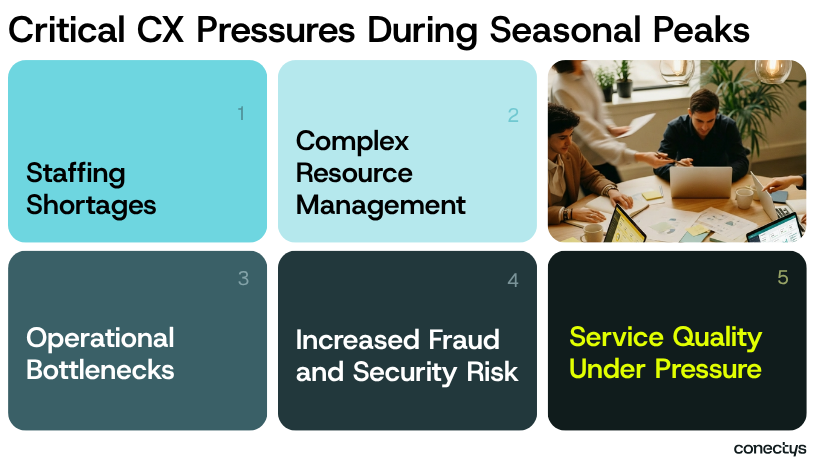
1. Staffing Shortages
Hiring, onboarding, and training seasonal agents on short notice is notoriously hard. Existing teams end up working longer hours, handling unfamiliar scenarios, and switching between channels at high speed. That combination increases errors, burnout, and inconsistent service.
Scalable customer support for busy periods depends on flexible capacity planning: a staffing model that blends internal teams, outsourced customer support, and on-demand GigCX, so you can ramp up quickly and right‑size again when volume stabilizes.
2. Complex Resource Management
Time, budget, and tools that are sufficient off‑peak become constraints during seasonal spikes. Suddenly, standard approval flows, manual reviews, or siloed tools create bottlenecks. Consumers wait longer, assistance feels less personalized, and quality drops.
Handling customer service requires sharper workload prioritization and smarter resource allocation, with clear rules for which issues to manage first, which channels to steer people to, and when to activate surge capacity.
3. Operational Bottlenecks
Legacy or disconnected systems often struggle under temporary load. Order updates get delayed, tickets fall through the cracks, and agents spend more time navigating systems than talking to each person. A single broken handoff can turn into long queues and unresolved complaints.
Seasonal customer experience strategy has to include process redesign and integrated, scalable CX and IT platforms: unified CRMs, routing engines, and knowledge bases that keep operations smooth even when volumes soar.
4. Increased Fraud and Security Risk
High‑demand seasons are also a prime time for fraud attempts and suspicious activity. More transactions mean more opportunities for chargebacks, account takeovers, and data misuse. If fraud workflows and security checks are not ready to scale, consumers and regulators notice fast.
Strengthening fraud controls and embedding scalable security checks into CX journeys is now part of delivering a trusted peak‑season customer experience.
5. Service Quality Under Pressure
When queues grow, agents feel forced to rush through interactions. That leads to incorrect answers, escalations, and repeat contacts, which in turn push volumes even higher. It’s a vicious cycle that erodes trust.
Training, live guidance, and targeted automation are essential to maintain high customer service standards under pressure, helping agents stay accurate, empathetic, and on‑brand even when the dashboard is red.
Here are some statistics from PwC that highlight what people expect from brands and help companies shape more effective CX strategies:
Around 70% of executives say customer expectations are evolving faster than their companies can adapt, increasing pressure on CX.
29% of consumers say they have stopped using or buying from a brand because of a poor customer experience, whether online or in person.
75% of consumers say it feels like brands do not consider whether customers actually want the technology they are investing in.
FAQ
When Peak-Season CX Breaks Down
Peak-season CX failures are easiest to understand through real‑world disruptions. Consider a large airline at the height of the holiday period. A winter storm forces schedule changes across the region. Hundreds of flights are cancelled. Thousands of passengers are stranded at airports for hours. The travel company faces a CX meltdown. Inquiries surge, compensation costs rise, and operations fall into chaos. Customers cannot rebook or reach anyone quickly, receive conflicting information across channels, and their frustration spills over onto social media and into news headlines.
What Happens When CX Loses Visibility?
But the real damage does not come from the unexpected weather conditions. It comes from flying blind on the CX front. Outdated technology, manual scheduling, a lack of proactive contingency planning, and weak operational resilience turn a foreseeable disruption into a full‑scale crisis.
Why Are Many CX Operations Fragile by Design?
Legacy, fragmented systems mean crew, aircraft, gates, and passengers are managed in silos, so once the breakdown begins, the airline cannot see a clear, global picture of where capacity and demand really are. At the same time, the CX layer, including apps, notifications, and frontline agents, is massively under‑tooled for the scale. Scary, but entirely possible, one of the worst‑case scenarios.
The Cost of CX Fragmentation
This kind of holiday CX meltdown illustrates what happens when there is no dedicated peak‑season strategy, no meaningful automation, and no reliable partner who can step in and come to the rescue. A single disruption can escalate into a full‑scale operational, reputational, and financial crisis. For organizations across industries, the lesson is simple: without a scalable customer experience framework, seasonal spikes and unexpected events will eventually expose every fragile link in your CX chain.
Designing a Scalable CX Strategy for Seasonal Spikes
A scalable peak-season CX framework defines how your operation absorbs seasonal spikes without sacrificing service quality or profitability.
Bold brands do not sit back and hope to “avoid disruptions” or that “it will all be over soon.” They are prepared, and more than that, they treat each unexpected event as a growth opportunity.
Instead of handling every surge as a one-off emergency, they design a scalable customer experience strategy that lets them flex capacity up and down, protect service quality, and capture more lifetime value from every new customer acquired during those moments. This is how peak season customer experience becomes a growth engine, not a liability.
What Are the Five Pillars of a Scalable CX Framework?
A scalable CX framework typically rests on five pillars: flexible capacity planning, omnichannel integration, technology enablement, on‑demand GigCX models, and performance metrics with real‑time optimization.
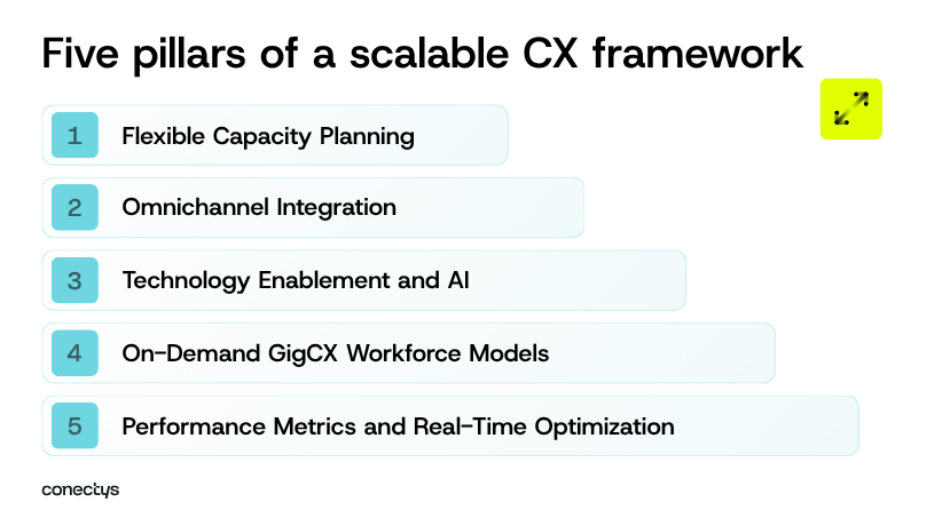
1. Flexible Capacity Planning
Scalable CX starts long before the high-demand period with disciplined forecasting. It means using historical interaction data, marketing and campaign calendars, product launch plans, and external signals to map demand curves by week, day, and even hour. At the same time, customer journey mapping makes those busy seasons tangible at a human level, showing where customers feel the most friction and which touchpoints are most critical to protect when volumes surge.
Based on this combined view of numbers and journeys, you can design specific coverage plans: which queues might need extra coverage, what language and skill mixes might be required, and when to open extended hours or additional shifts. Internal teams, long‑term partners, and fixed seasonal hires can be planned in advance around these scenarios, so the baseline capacity is in place well before the surge begins.
2. Omnichannel Integration
A scalable framework for peak‑season customer experience unifies CX data into a single view. Agents can see context, history, sentiment, and intent across channels in real time, which is critical when every second counts.
Because chat, email, voice, and social channels are integrated, people can start in one channel and continue in another without repeating themselves. Omnichannel customer support during the rush times reduces effort, speeds resolution, and lets CX leaders dynamically shift volumes between channels while preserving a consistent, branded experience everywhere.
3. Technology Enablement and AI
Technology amplifies CX teams, especially during seasonal spikes. AI‑driven routing and automation triage intent, language, and priority in milliseconds, directing each contact to the best‑suited agent or bot. That reduces wait times, increases first‑contact resolution, and protects SLAs when volumes surge.
Self‑service options such as chatbots, embedded FAQs, and searchable knowledge bases allow consumers to solve simple issues independently. For e‑commerce and digital‑first brands, this blend of human talent and AI-powered service is now mandatory to maintain a scalable, resilient customer experience at peak. The goal isn’t to remove humans, but to free them to focus on complex, high‑value interactions.
4. On-Demand GigCX Workforce Models
Even with strong forecasts, reality rarely follows the curve exactly. That’s where on-demand GigCX workforce models come in. They provide fast, flexible reinforcement by activating pre‑trained, brand‑aligned agents precisely when and where demand spikes.
This approach gives CX leaders access to new skills, languages, and channels without long hiring cycles or permanent fixed costs. Integrated with routing and performance systems, GigCX helps protect service quality, reduce strain on core teams, and turn unpredictable spikes into a manageable, repeatable capacity lever. Capacity expands in hours, not weeks, while empathy, language coverage, and brand voice remain intact.
5. Performance Metrics and Real-Time Optimization
Scalable CX lives and dies by the right metrics, especially during seasonal changes. CSAT, first response time, resolution rate, and cost per contact provide a live view of whether volume, quality, and cost are in balance.
Real‑time dashboards let operations managers spot anomalies early, test operational tweaks, and roll out changes without waiting for end‑of‑month reports. This continuous optimization loop turns the peak‑season CX framework into a living system that learns from every campaign, every season, and every unexpected event.
Elastic CX Capacity: Blending In-House, Outsourcing, and GigCX
When customer demand becomes unpredictable, scaling customer experience through internal teams alone is rarely sufficient. Seasonal spikes, new market entries, and sudden demand surges require a more flexible operating model, one that can expand and contract without compromising service quality or operational control.
This is where an elastic CX capacity comes into play. By combining in-house teams with customer experience outsourcing and on-demand GigCX, organizations can create a layered support structure that adapts in real time. Internal teams continue to handle core, high-value interactions, while outsourced and gig-based agents provide surge coverage across channels, languages, and time zones.
A well-matched outsourcing partner brings more than just additional headcount. It provides ready-built infrastructure, trained teams, and proven processes that would take years to develop internally. When integrated properly, this hybrid model allows companies to scale customer support quickly, maintain consistency across markets, and align costs with actual demand. Increasingly, this blend of outsourcing and GigCX is becoming a defining element of scalable customer experience strategies.
According to Deloitte, organizations increasingly lean on outsourcing: 42% say it gives them access to talent they cannot build in‑house, 29% use it to accelerate innovation and CX transformation, and nearly half of those using AI‑enabled outsourcing report higher efficiency and reduced effort. Taken together, these shifts make outsourcing a genuine game changer during both normal operations and unexpected busy periods.
Using AI and Automation to Protect Peak-Season Customer Experience Quality
Technology plays a critical role in ensuring that service quality does not deteriorate under pressure. During peak periods, AI and automation act as force multipliers, helping teams absorb higher volumes without creating bottlenecks or overwhelming agents.

The most effective implementations focus on practical impact. AI-driven routing ensures that incoming queries are prioritized and directed based on urgency, complexity, and customer value. Automation handles repetitive tasks, such as order tracking or account updates, freeing human agents to focus on more nuanced interactions. At the same time, agent-assist tools provide real-time guidance, surfacing relevant knowledge and suggested responses to improve accuracy and speed.
Keeping CX Human in an Automated World
However, scalability cannot come at the expense of trust. Maintaining a human-centered approach is essential. Customers should know when they are interacting with automation, and escalation paths to live agents must remain clear and frictionless. Continuous monitoring is equally important to ensure that responses remain accurate, compliant, and aligned with brand voice. When deployed thoughtfully, AI strengthens both efficiency and experience, rather than forcing a trade-off between the two.
Gartner has predicted that by 2026, conversational AI deployments in contact centers will reduce agent labor costs by $80 billion globally, which shows why buyers now expect automation to deliver measurable operational impact, not just chatbot coverage.
Omnichannel, Multilingual CX That Scales with Demand
Customer behavior during peak periods is fluid and channel-agnostic. People move between chat, email, voice, and social platforms depending on urgency and convenience, often within the same interaction. A fragmented CX setup cannot keep up with these patterns, especially when volumes are high.
A scalable approach to omnichannel customer experience connects these touchpoints into a single, continuous journey. People can start a conversation in one channel and continue it in another without repeating information, while agents retain full visibility into context, history, and intent. This not only reduces resolution time but also minimizes frustration at moments when patience is already limited.

For global organizations, the challenge extends further into language and localization. Delivering a multilingual customer experience at a scale requires more than translation. It demands cultural alignment, consistent tone, and region-specific knowledge. Combining centralized frameworks with localized expertise ensures consistency across markets while preserving regional specificity.
KPI Framework for Peak-Season Customer Experience Performance
Importantly, handling higher volumes is not, on its own, a measure of success. A mature peak-season CX strategy must demonstrate that increased demand translates into both strong customer experience and tangible business outcomes.
This requires a balanced view across operational, experiential, and commercial metrics. Indicators such as first response time, resolution rate, and cost per contact reveal how efficiently the operation is running. At the same time, CSAT, sentiment, and complaint rates show whether service quality is being maintained under pressure. Ultimately, the most important signals come from business impact: conversion rates, repeat purchases, and customer retention after the surge subsides.
When tracked in real time, these metrics allow teams to adjust quickly, rather than waiting for post-season analysis. More importantly, they shift the role of CX from a cost center to a measurable driver of growth.
Preparing Your CX for High-Season: A 90–60–30 Playbook
A 90–60–30 CX playbook turns peak‑season forecasting into timed, actionable preparation before demand surges.
Ultimately, effective performance begins long before demand starts to rise. Organizations that consistently deliver during high-pressure periods follow a structured preparation model that turns forecasting into operational readiness.
Around 90 days before the disruption, the focus is on understanding demand patterns. Historical data, campaign plans, and external factors are analyzed to build accurate forecasts and identify pressure points across the customer journey. At this stage, decisions around capacity, technology investments, and process adjustments are made.
At the 60-day mark, planning shifts into execution. Hiring and outsourcing strategies are finalized, knowledge bases are updated, and teams are trained for high-volume scenarios. Simulation exercises and playbooks help prepare for edge cases and unexpected disruptions. This is also when on‑demand capacity models such as GigCX are tested and made operationally ready, ensuring rapid activation if forecasts shift.
In the final 30 days, attention turns to validation. Systems are stress‑tested, routing logic is refined, and dashboards are configured for real‑time monitoring.
Real-Time Operations: Running CX Like a Control Room
Even the most robust plans must adapt to real-world volatility. During surges, leading CX teams operate with a control-room mindset, where decisions are driven by live data and rapid feedback loops.
Daily operations revolve around real-time dashboards that track service levels, backlogs, and channel performance. Teams hold short, focused check-ins to reassess priorities and make immediate adjustments. When disruptions occur, whether operational, technical, or external, capacity can be reallocated quickly, routing rules updated, and additional help activated in real time through pre-integrated external support models.
At the same time, continuous quality monitoring ensures that speed does not come at the expense of accuracy or brand consistency. Coaching, feedback, and QA processes remain active throughout, reinforcing standards even as pressure increases.
This ability to respond dynamically is what turns volatile times into manageable, controlled events.
How Peak-Season CX Becomes Your Next Growth Engine
Hectic periods will always bring an element of unpredictability. External factors, from weather disruptions to viral demand spikes, cannot be fully controlled. What businesses can navigate, however, is how prepared their customer experience is to absorb and respond to that volatility.
A scalable approach, built on elastic capacity, AI-enabled operations, omnichannel integration, and strong execution discipline, allows companies not only to withstand demand surges but to capitalize on them. As a result, each interaction becomes an opportunity to reinforce trust, drive conversion, and build long-term loyalty.
In this context, peak-season customer experience is no longer just a stress test. It becomes a strategic lever, one that transforms short-term spikes into sustained growth.
Seasonal spikes don’t have to mean missed SLAs, stressed teams, and lost revenue. Book a conversation with our team to see how elastic CX capacity, outsourcing, and GigCX can stabilize your operations and grow customer lifetime value.