
Key Points
- An omnichannel contact center is a connected CX operation where every channel shares the same customer history and context, which is crucial for seamless support.
- Companies using this model retain far more customers than siloed setups.
- Why? Your customers expect service that feels personal and always available, while your board wants lower costs and higher CSAT.
- An omnichannel contact center is where those pressures meet
- Choosing the right omnichannel contact center provider often determines your CX success.
Why Omnichannel Contact Centers Matter
Nowadays, an omnichannel contact center is no longer a nice‑to‑have solution. It stands as the CX operating system that connects every customer interaction into one continuous journey across voice, digital, and self‑service channels.
Consumers now expect fast, seamless support on their preferred channels. On the other hand, boards expect lower cost to serve, higher CSAT and clear revenue impact. Omnichannel customer support is one of the few models that can meet both expectations.
This guide explains what an omnichannel contact center is, how to design and implement one, how to choose the right provider, and how AI and cloud‑native platforms fit into your roadmap.

What Is an Omnichannel Contact Center
An omnichannel contact center is a CX environment that connects all brand and customer communication channels in a single, unified system.
When someone interacts with your business for the first time, they become a unique customer profile whose actions, behaviors and intents are captured and remembered. Context follows them across engagement points, so every conversation continues with full history instead of starting from zero, and people can switch between touchpoints without extra effort.
This approach makes a difference because consumers today are no longer impressed by companies that simply offer many channels. They expect consistent support and fast resolution on their preferred channels, no matter where, how or when they enter the experience.
In an omnichannel contact center, people are more important than channels. The customer’s identity and history come first, while communication points become flexible entry gates into the same service journey. Over time, this reduces friction, increases satisfaction, strengthens loyalty, and secures future revenue.
For global companies, this clearly raises the bar. Traditional CX setups are often not enough. Transformation is necessary to move beyond competing on scorecards alone and to start winning on outcomes.
CX leaders should now ask, “How do we build it well, how fast and with which omnichannel contact center providers?” instead of “Do we need omnichannel at all?”
The global omnichannel customer service market was valued at $8.5 billion in 2025 and is expected to reach $18.2 billion by 2034. This represents a compound annual growth rate (CAGR) of 9.8% over the forecast period, according to Data Intelo. The direction is clear: omnichannel customer service is becoming a core investment area for CX‑driven brands, not a niche add‑on.
Which Companies Need Omnichannel Customer Experience?
An omnichannel contact center is a valuable solution for organizations seeking to centralize customer relationships, optimize performance, enhance service consistency, and scale CX operations effectively.
For companies with recurring shopper interactions, a truly omnichannel contact center quickly becomes a must‑have. It is particularly critical for B2C firms and service‑heavy industries such as retail and e-commerce, gaming, software, financial services, tech/SaaS, travel and hospitality, and healthcare.
In these sectors, customer journeys are typically long, repeated, and multifaceted, spanning many touchpoints. At the same time, consumers expect fast, convenient, and impactful assistance, regardless of the circumstances or seasonal disruptions.
| Type of company | Why omnichannel is important |
| Retail & e‑commerce | Links browsing, buying, and support across channels, so shoppers get quick, consistent help before and after the sale. |
| Travel & hospitality | Connects booking, check‑in, and disruption updates across app, web, phone, and social, so trips stay smooth even when plans change. |
| Financial services | Keeps every sensitive interaction (claims, loans, disputes) in one history, so customers get secure, reliable answers wherever they reach out. |
| Gaming | Follows players across in‑game chat, forums, social, and support tickets, so issues are solved fast and communities stay healthy. |
| Software & SaaS | Tracks user questions across in‑app chat, email, and community, giving teams the context they need to fix problems and prevent churn. |
| Healthcare | Connects calls, portals, messages, and telehealth visits, so patients don’t have to repeat themselves and care teams see the full picture. |
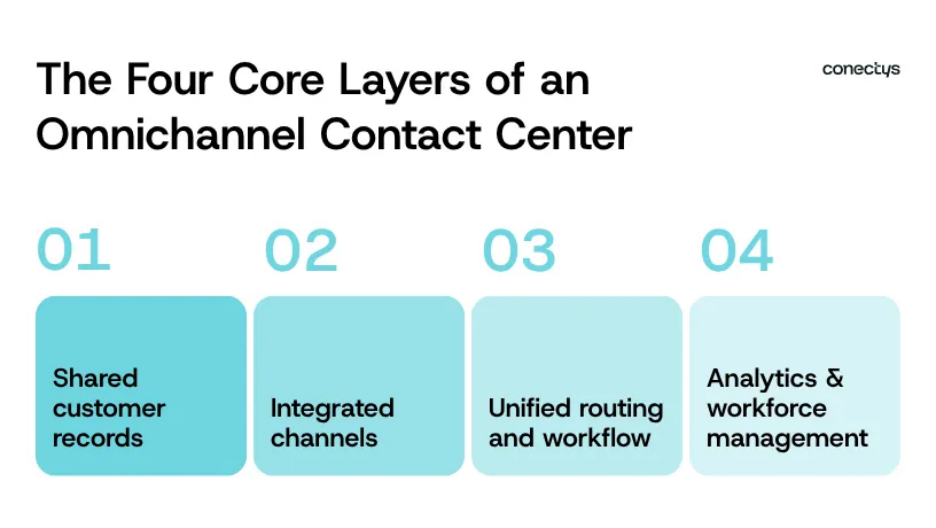
The Four Core Layers of an Omnichannel Contact Center
Although channels are important for shoppers, they are only the interface in the omnichannel setup. What truly defines the platform is the invisible engine beneath. Systems, data, analytics, and workflows work together to turn scattered exchanges into one continuous customer conversation.
1. Shared customer records
This layer keeps a single, unified profile for each person, so context is never lost between interactions. It typically includes CRM and ticketing systems, order and billing data, customer profiles, and preferences. Additionally, the integration services keep these records in sync.
2. Integrated channels
In the integrated channels layer, all customer‑facing touchpoints are tied into the same system and share the same customer data. That way, when people move between voice, email, chat, SMS, WhatsApp, social media, self‑service tools or in‑app messaging, the experience still feels coherent and continuous.
3. Unified routing and workflow
At this level, the system decides where each interaction goes and how handoffs work when customers change channel, language or intent. Key components include the routing engine, skills‑based routing rules, workflow automation, and bots that handle or triage specific tasks.
4. Analytics and workforce management
This part of the stack provides visibility into complete CX journeys, not just queues, and helps leaders improve staffing and channel experiences based on real data. It relies on reporting and dashboards, QA and compliance tools, workforce management, alerts, and journey analytics.
In practice, an omnichannel contact center is the operating system that keeps all your customer conversations in sync, no matter where they start or how many times people switch channels.
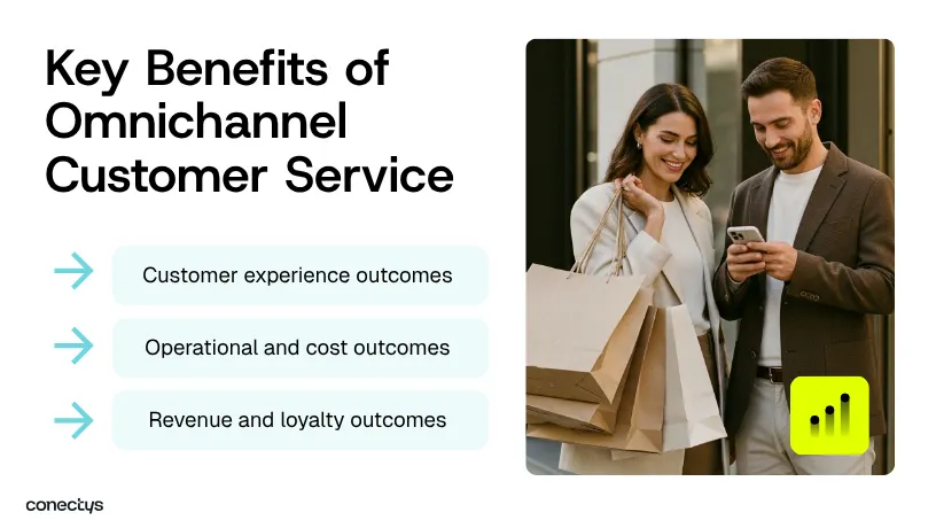
Key Benefits of Omnichannel Customer Service
For companies that serve consumers across multiple channels, moving to an omnichannel model delivers far better outcomes across experience, operations, and revenue. The benefits fall into three key groups, and these lenses make it easier to build a business case and compare potential providers.
1. Customer experience outcomes
From the shoppers’ point of view, omnichannel customer service keeps context intact across channels and over time. People spend less time repeating issues or navigating disconnected systems.
This lower effort shows higher CSAT, NPS, and effort scores, especially when paired with clear SLAs and proactive support. It also sustains consistent service across markets, which is critical for global brands under C‑level scrutiny.
2. Operational and cost outcomes
On the operations side, an omnichannel contact center uses shared routing and workforce management to balance work across channels instead of staffing each queue in isolation. That reduces transfers, smooths peaks, improves occupancy, and lowers cost per contact without sacrificing quality.
For instance, one of Conectys’ omnichannel CX projects has delivered improvements by combining AI-powered platforms with trained agents, such as:
- Ticket deflection up to 45%
- Average handling time down by 30%
- Efficiency up to 45%
- Customer satisfaction up to 35%
3. Revenue and loyalty outcomes
Better journeys and lower friction reduce churn, improve renewals, and create more chances to cross-sell or upsell in context. When agents see the full story and the technology surfaces intent or risk signals, they can act at the right moment instead of reacting late.
Over time, this mix of strong omnichannel customer experience and efficient operations builds higher lifetime value and more resilient recurring revenue, which is why boards increasingly treat omnichannel as a strategic growth lever, not just a cost center upgrade.
According to research reported by Invesp and widely attributed to Aberdeen Group, companies with omnichannel customer engagement strategies retain, on average, 89% of their customers, compared with about 33% for companies with weak omnichannel engagement.
FAQ
Omnichannel Contact Center Trends
The top omnichannel contact center trends are AI‑powered support journeys, cloud‑native contact center platforms, and real‑time journey analytics. Together, they are shifting buyer expectations away from long feature lists and towards clear business outcomes such as faster resolution, lower costs, and better customer satisfaction.
AI and automation in omnichannel contact centers
Market outlooks show steady growth for omnichannel customer service and communication platforms as organizations move from voice‑heavy contact centers to digital‑first, AI-enabled operations. AI now supports agents, powers self‑service, and optimizes routing and analytics in omnichannel contact centers. Generative and agentic AI can summarize conversations, suggest replies, and solve common requests across chat, messaging, and voice. It allows human agents to focus on complex or sensitive cases.
The real differentiator is not “having bots,” but how deeply AI is embedded into service workflows, backed by clean, continuous customer data.
According to Gartner, conversational AI is set to reduce contact center agent labor costs by $80 billion globally by 2026, reinforcing the shift in buyer expectations toward measurable operational impact rather than basic chatbot deployment.
Cloud‑native architecture
Cloud‑native omnichannel contact centers give CX leaders the flexibility to scale, add new channels such as WhatsApp, and integrate with CRM or data warehouses quickly. Elastic, multi‑region, API‑first platforms make it easier to enter new markets or modernize legacy environments without major disruption. For companies debating build vs. buy vs. outsource, cloud‑native architecture often decides how fast they can change and how future‑proof their CX stack will be.

Advanced analytics and real‑time insights
Analytics are finally catching up with omnichannel complexity. Modern platforms show full customer journeys across channels, not just isolated SLAs, revealing where experiences get stuck and where customers tend to drop off. Real‑time dashboards, cross‑channel attribution, and predictive models for churn or intent help leaders route smarter, intervene earlier, and design journeys that balance satisfaction and cost.
Emerging channels and customer expectations
New channels keep appearing, from in‑app messaging and conversational commerce to richer video and early AR/VR support. In many regions, WhatsApp combined with AI assistants has already become table stakes. The strategic question is which channels truly matter to your customers and how easily your CX partner can add or retire them without breaking journeys. This is why many RFPs now explicitly call out “omnichannel contact center WhatsApp integration and AI capabilities” as must‑have requirements.
How to Implement an Omnichannel Contact Center: Framework
To implement an omnichannel contact center, plan a 3 to 12‑month program across five phases: assess, design, select, pilot, and embed.
1. Assess and diagnose your current state
Map existing channels, volumes, SLAs, pain points, and data silos. Identify legacy blockers, clarify target journeys, roles, and governance, and decide which parts you will own versus where outsourcing partners such as Conectys will participate.
2. Design your omnichannel model
Translate your findings into a target omnichannel contact center design: which journeys to prioritize, which channels to support, how routing and handoffs should work, and what success metrics you will track at the journey level. Use this as the blueprint for both technology and operating changes.
3. Select and integrate your stack
Choose omnichannel contact center technology with strong APIs, CRM and back‑office integration, plus built‑in WFM, QA, and real‑time reporting. Integrate in phases around legacy systems, avoid big‑bang cutovers, and ensure every channel writes to the same customer profile.
4. Pilot and refine
Run pilots on a narrow scope, such as a single region, segment, or product, with clear KPIs. Use results to refine routing rules, knowledge structures, AI assistance, and escalation paths, and involve agents in feedback loops to improve usability and adoption.
5. Scale and embed omnichannel as “how you work”
Extend the model to more markets and segments while keeping standards consistent. Align WFM, QA, and coaching with journey‑level metrics instead of isolated channel SLAs, and make data quality, CX governance, and continuous improvement part of daily operations so the contact center remains adaptable rather than becoming a new legacy system.

Common Omnichannel CX Challenges
Most large-scale omnichannel customer service projects stumble on data silos, legacy systems, and unclear ownership of journeys and outcomes, not on the core technology itself. Spotting these issues early helps you design an omnichannel contact center that works in reality, not just on paper.
1. Legacy system integration
Many brands still run on old telephony, home‑grown tools, and departmental apps. Rather than a risky “big bang” replacement, using an API‑first approach that wraps legacy systems and swaps them out gradually by region or product line is usually safer.
2. Agent resistance to change
If omnichannel means more tools, more screens, and more complexity, agents will push back. Involving frontline teams in journey design, simplifying their interfaces, and supporting them with training and coaching helps them clearly see the benefits.
3. Data silos and data quality
Omnichannel depends on shared, accurate data. Duplicate or inconsistent customer records quickly break the experience. Defining a system of record, setting governance rules for updates, and using validation practices keeps data clean and compliant.
4. Operational complexity and forecasting
Managing volume and channel shift across synchronous and asynchronous touchpoints is harder than running voice only. Using a unified view of demand, realistic handling times, and blended workforce management rules helps keep service levels stable.
5. Cost, ROI, and governance
Omnichannel CX requires investment, so leaders expect proof that it pays off. Agreeing metrics upfront, such as CSAT, NPS, first‑contact resolution, cost per contact, and revenue per interaction, and tracking improvements against them builds a solid ROI story.
When to Consider Omnichannel CX Outsourcing to a Specialist Partner
There comes a point where outsourcing your omnichannel contact center becomes the more pragmatic choice. That moment usually arrives when you need to scale fast, lack internal expertise, or want to reduce transformation risk. In these situations, a specialist BPO partner combines strategy, platforms, and operations so you can focus on CX outcomes instead of building everything alone.
The need for a partner is clear when three pressures collide:
- First, you must expand into new regions or languages, but building full in-house operations everywhere is too slow or too expensive.
- Second, your teams lack experience designing end‑to‑end omnichannel journeys and connecting all the systems.
- Third, you want to avoid learning every hard lesson yourself and prefer proven playbooks, tools, and workforce practices.
A specialist outsourcing company builds on this by aligning strategy, technology, and operations under one roof. Strategically, they support assessments and roadmaps. Technologically, they provide cloud‑based omnichannel contact center platforms integrated with AI, analytics, QA, and WFM. Operationally, they supply trained agents and leaders who run programs day‑to‑day.

How to Choose an Omnichannel Contact Center Provider
When choosing an omnichannel contact center provider, look for five things: language and regional coverage, smooth integration with your existing stack, proven success at a similar scale and complexity, strong compliance capabilities, and pricing aligned with your volume and risk profile.
Here are the practical steps to get started:
- Start by checking language and regional coverage against your current and planned markets. Then validate the provider’s omnichannel contact center technology stack and integrations, especially with your CRM, ticketing, and data platforms.
- Ask for case studies that resemble your own scale and complexity, and clarify how pricing works across agents, interactions, and outcomes.
- Finally, confirm data ownership and governance, so you know exactly where customer data lives and how it is protected.
Best Practices for Omnichannel Customer Service
The most important best practice for omnichannel customer service is to anchor every channel in a single, trusted customer record. From there, design journeys rather than isolated channels, invest in agent experience and AI assistance, and measure performance at the journey level instead of only by channel SLAs.
Treat omnichannel customer support best practices as an ongoing operating model, with continuous iteration and governance, rather than a one‑time technology project.
Ready to upgrade your omnichannel customer experience?
If you are evaluating whether to build your omnichannel contact center in-house or partner with a specialist provider, we can help you move faster with less risk.


