
AT A GLANCE
Most teams already use journey maps to see what customers do, feel, and decide as they move through an experience. BTO (Business Transformation Outsourcing) goes further by turning those maps into a shared blueprint that continuously redesigns journeys, policies, and workflows across both client and provider teams.
Key Points
- Journey mapping becomes the operating system for BTO, not a one‑off workshop.
- AI‑enabled data, orchestration, and governance connect front‑stage experiences with backstage operations.
- Outcomes are measured in churn, CSAT, cost‑to‑serve, and revenue impact, not just “better experience.”
Introduction
Journey mapping is a way to visualize the real end‑to‑end experience customers have with your brand across channels, time, and teams. Consumers today rarely follow a single, linear path to purchase. In a hyperconnected world, they move between channels, devices, and teams, creating dozens of small but meaningful touchpoints that collectively define their experience with a brand. All of these interactions add up to a continuous stream of contacts happening every single day. To make sense of this complexity, this entire flow is often described as the customer journey.
For instance, in 2025, the average number of touchpoints before a purchase was just under 29, though this can vary significantly by industry, according to Chase McGee.
From Idea to Execution
For businesses, the real value of customer journey mapping lies in continuous use, not just naming the concept. That means mapping the path continually to see how it works, where it flows smoothly, where it breaks, and where it can be redesigned on purpose rather than by accident.
Who Owns the Journey?
Customer journey mapping only drives change when clear owners and a cross‑functional team are accountable for it. That immediately raises a critical question: who should actually own the journey in the organization? In reality, customer journey mapping cannot be handled by a single team. It needs clear executive owners and a cross‑functional coalition around them, so decisions translate into real change.
Internally, this work depends on an ecosystem of specialists and tools, from experienced managers and service designers to analytics platforms and orchestration systems. Externally, as more companies outsource CX, your partner must be explicit about whether journey mapping is truly in scope or just assumed in the background.
An Era of Journey‑Led Transformation
This is where a Business Transformation Outsourcing (BTO) partner proves its value. In a BTO relationship, clarity about the journey is non‑negotiable: a true partner treats client‑centric thinking as a core capability, built directly into the growth engine you are creating together around customer experience.
Proof in the Numbers
Returning shoppers, rising satisfaction, and repeat purchases are the clearest proof that this approach works. You see it in the metrics, too. According to MediaPlus, companies that manage customer journeys well:
Can increase client satisfaction by roughly 20%.
Lift revenue by roughly 15%.
Cut serving costs by about 20%.
Ultimately, this guide shows CX decision‑makers how to use customer journey mapping, and with which partners, to turn fragmented experiences into a repeatable, measurable framework.
What Is Customer Journey Mapping?
Customer journey mapping is the practice of documenting and analyzing the end‑to‑end experience a person has with your business, from first contact to post‑purchase and beyond. In practice, it becomes a visual representation of the key stages, touchpoints, actions, emotions, and pain points people move through in your ecosystem of products and services across channels and over time.
However, a typical journey map should not remain just a static diagram. It needs to become a data‑driven story told step by step, built on insights from your teams and the strategic support of your BTO partner, who translates every key moment into clear ownership, operating changes, and measurable impact.
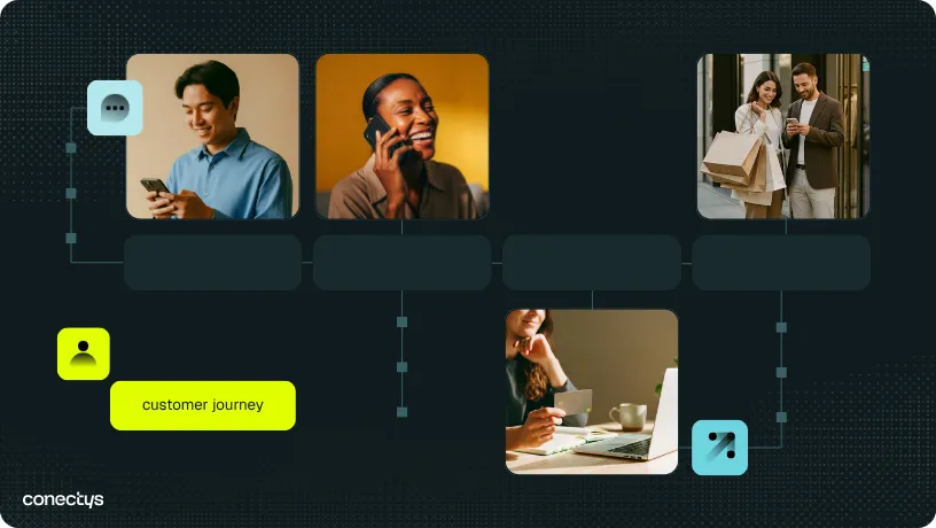
Here’s how it works in practice when done exactly as it should be:
1. From Data to Story
First, each customer in the process is clearly captured and anchored to a specific persona and goal. These can range from a first‑time buyer trying to set up a product in under 10 minutes to a long‑time client looking for a quick way to upgrade their plan. Framing journeys this way ensures everyone in the CX team knows exactly whose path they are examining and what that individual is trying to achieve.
2. Seeing the Real Interactions
Second, journey mapping captures what really happens, not just neat fiction in internal process documents. From the ads people actually see, to the comparison pages they open, the chatbot they try, the call they make, the email they ignore, and the handoffs between teams they feel but are never aware of, it records it all with precision. With this level of detail, you can follow each path screen by screen and conversation by conversation, across channels and devices, as buyers move forward, stall, or drop out.
Industry: Potential Touchpoints for Mapping
| Industry | Potential touchpoints for mapping (examples) |
|---|---|
| Software | Free trial signup, onboarding flows, in‑app guidance, support tickets, renewals, expansion/upsell moments |
| Gaming | Account creation, first‑time user experience, gameplay issues, community moderation, fraud/ban appeals |
| E‑commerce / Retail | Browsing and cart, checkout, payment issues, delivery updates, returns, loyalty and re‑engagement campaigns |
| Fintech / Payments | KYC and onboarding, transaction support, disputes/chargebacks, account changes, compliance notifications |
| Travel & Hospitality | Search and booking, pre‑trip changes, check‑in, on‑trip support, cancellations, refunds, reviews |
| Consumer Electronics / HW | Product registration, setup and activation, troubleshooting, repairs/RMA, warranty and upgrade offers |
3. Spotting Moments That Matter
Third, mapping pulls out the “moments of truth” where the stakes are highest. It might be a confusing pricing page, a delayed delivery update, or the quiet relief after an agent fixes everything in two minutes. These are the points where emotions spike and where people really decide whether to stay, leave, complain, or buy again.
From Journey Map to Daily Management System
The path described above shows how to turn raw client–brand interaction data into a concrete, human story that can be seen, designed, and improved to strengthen the bond of mutual history between you and your customers. This approach still requires the right strategy, people, tools, and a collaboration model that everyone is truly committed to. In other words, the journey stops being a one‑off workshop deliverable and becomes the way you and your BTO partner run the business, day to day.
FAQ: Common Questions from CX Leaders
When Customer Journey Becomes the BTO Operating System
In Business Transformation Outsourcing, customer journey mapping serves as a joint blueprint that outlines both the shopper’s path and the operating model that supports it. Simply put, the same story comes into focus under the backstage lights, so you see not only what clients live through but also how outsourced teams, processes, and SLAs shape it. As a result, it becomes much easier to spot where responsibilities blur, where handoffs between the client and BTO provider break down, and where governance needs to be tightened.
Key Components of a BTO‑ready Journey Map
A BTO‑ready customer journey map combines classic CX elements with a second layer for people, process, tech, and AI. Once you treat the journey map as your BTO operating system, the next question is: what should actually be on it? In CX, teams still use familiar building blocks such as personas, stages, touchpoints, emotions, and pain points.
In Business Transformation Outsourcing, you add a second layer that shows how the provider’s people, processes, technology, and AI are intended to deliver against those moments.
| Component | What it includes |
|---|---|
| Customer personas | Client decision-makers, ops leaders, end customers, and internal users rely on the BTO team. |
| Clients’ goals | What each person wants at each stage (e.g., fast resolution, higher CSAT, predictable volume, and quality). |
| Journey stages | Customer phases (awareness to expansion) aligned with BTO phases (design, pilot, steady state, optimization). |
| Touchpoints and channels | All interactions the BTO team handles or influences across voice, digital, and review/reporting moments. |
| Actions, questions, emotions, pain points | What people do, ask, feel, and struggle with at each step, plus sentiment and key CX metrics. |
| Internal processes and SLAs | Client decision makers, ops leaders, end customers, and internal users are relying on the BTO team. |
| Technology and AI enablers | Client and provider workflows, SOPs, routing, and KPIs are mapped directly to touchpoints. |
| Governance and decision rights | Who owns which parts of the journey, who can change flows, and how joint decisions and escalations work. |
Ultimately, when you put all these components together, you get more than a pretty customer journey map. You get a shared, AI‑aware operating blueprint that CX leaders, product teams, and their BTO partner can use to decide what to fix next, which experiments to run, and how to prove ROI in language the CFO recognizes.

Instead of abstract discussions about “experience,” CX and outsourced teams can point to the same map and agree on concrete changes to the operating model. That is the edge of customer journey mapping in BTO projects: it is designed from the start to plug into your data, tech stack, and contracts, so every updated stage, step, or touchpoint can be traced back to measurable outcomes in cost, CX, and growth.
Benefits of Customer Journey Mapping for BTO Clients
Customer journey mapping for BTO clients matters because it connects CX work directly to revenue, cost, and risk. The benefits of journey mapping are most compelling when they show up in your P&L, meaning they are reflected in your actual revenue, costs, and margins. Done properly, customer journey mapping in BTO projects supports outcomes that both CX leaders and finance teams can see and track.
Many companies already recognize this. According to research from Custom Market Insights, the global journey mapping market is projected to grow at about 14% per year from 2025 to 2034, rising from roughly 1.2 billion USD to around 4.5 billion USD over that period, underscoring how rapidly organizations are investing in this capability.
Key Gains for Clients
Reduced churn and higher retention by finding the moments where customers silently give up. These include long onboarding, confusing self‑service, or inconsistent answers across channels.
Higher CSAT and fewer complaints, by smoothing the rough edges between tiers, teams, and providers, and closing the gap between what marketing promises and what service delivers.
Better revenue and more efficient operations, by designing journeys that surface value at the right time and exposing needless transfers, duplicated work, and policy friction that drive up effort and cost‑to‑serve.
To keep these gains from becoming a pretty poster, you need to tie them to measurable outcome buckets. You are not just asking, “Is this journey pretty?” You are asking, “Does this journey pay rent?”
Business Outcomes You Can Quantify
CX: higher satisfaction scores, fewer formal complaints, better sentiment in surveys, and conversation analytics. Fewer customers are stuck in “contact us again” loops.
Operational: fewer transfers between queues, lower handle time on recurring intents, less rework on tickets, and cleaner escalations to L2 or engineering.
Revenue: better conversion at sales‑adjacent support moments, higher renewal rates, and stronger cross‑sell on retention‑sensitive touchpoints.
Ultimately, it is crucial to note that journey mapping reveals the gap between your brand promise and the experience you actually deliver. This is a positive outcome because it gives both sides, your company and Business Transformation Outsourcing partner, a neutral, shared view of where the relationship is working and where services or processes need to change.
Role of a Modern Tech Stack in Customer Journey Mapping for BTO
A modern tech stack makes customer journey mapping executable by connecting data, automation, and analytics to each step. Even the best workshop will stall if you do not have the right technology to automate tasks and support people with reliable analytics and insight. Your tech stack simply has to see, connect, and improve the customer journey end‑to‑end. In BTO projects, this becomes the engine that turns journey maps into live, testable operating models, backed by proven platforms and teams of specialists who know how to tune them for measurable impact.
The Must‑have Foundation
Today’s must‑have layer is a clean foundation of CRM, ticketing, contact‑center, QA/knowledge, and digital analytics tools, all joined around a single customer ID and shared KPIs. On top of that, you need production‑grade AI for intent detection and routing, virtual agents and chatbots, agent‑assist copilots, and conversation analytics that turn calls and chats into structured journey data in real time.
For journey mapping, three AI‑centric capabilities matter most nowadays:
Unified data: Pipelines that stream interaction, sentiment, and outcome data from every channel into one model of the journey, not separate channel views.
Orchestration and automation: Low‑code tools that let you turn journey decisions into new flows, routing logic, and self‑service steps without months of custom builds.
Observability: CX and operations dashboards that show how a change in one step affects handling time, CSAT, churn, or revenue further down the journey.
From Tooling to an Autonomous CX Layer
Looking ahead, the future stack is increasingly agentic and predictive: AI that can propose new journey variants, simulate impact on demand and staffing, and automatically adjust bots, queues, and knowledge when patterns shift. In a BTO relationship, these capabilities must plug into the client’s CRM, product, and data estate, with clear rules for systems of record, data flows, and AI governance, so that decisions are explainable and auditable.
When all of this is in place, the journey map becomes the front end of how your CX engine runs: each stage and touchpoint links to specific bots, queues, and SLAs, so teams move from ‘we see a pain point here’ to ‘we know exactly which AI model, rule, or script to change’ in a single discussion.

Sales vs. CX: Two Flavors of Journey Mapping
Customer journey mapping can describe both sales funnels and long‑term CX relationships, which serve different questions. Customer journey mapping may refer to both CX and sales journeys, so it is worth being clear about how the latter looks and what it is for. By setting it up this way, sales teams can see where opportunities stall, where prospects drop out, and which steps consistently move deals forward. That makes it easier to remove friction, shorten cycle times, and improve win rates.
On the other hand, CX‑oriented maps focus on the wider relationship before, during, and after the sale. Used together, both solutions show how people move to a decision and how they experience everything around and after that decision. This combination lets you design journeys that convert in the short term while also retaining and growing buyers over the long term.
Here’s a quick comparison between CX and sales journey maps:
| Aspect | CX journey map | Sales journey map |
|---|---|---|
| Focus | Full relationship over time | Path from lead to closed deal |
| Typical stages | Onboarding, use, support, renewal, advocacy | Lead, qualification, proposal, negotiation, close |
| Key objectives | Loyalty, satisfaction, retention, LTV | Conversion, win rate, cycle length |
| Typical owners | CX, service, product, operations | Sales, account management, revenue ops |
| Core questions | “How does it feel to be our customer?” | “What helps or slows this deal right now?” |
How to choose the right BTO partner for journey‑led CX
Choosing the right BTO partner for journey‑led CX means finding someone who can co‑design, measure, and run your key journeys. You need a provider that can co‑own the initiative entirely, bring the right mix of strategy, talent, and technology, and treat the journey map as a living operating blueprint, not a one‑off workshop slide.
1. Start with outcomes and non‑negotiables
Be explicit about what you want the partnership to achieve: lower churn on a specific journey, faster resolution on key intents, safer AI adoption, expansion into new markets, or all of the above. Define success metrics (CSAT, NPS, churn, cost‑to‑serve, compliance) and non‑negotiables (brand tone, regulatory constraints, data residency). Do it all before you look at vendors, so you can judge proposals against a clear brief.
2. Check industry and journey‑mapping maturity
Look for a BTO partner with proven experience in your vertical and evidence that they already use customer journey mapping as a management tool, not just a workshop deliverable. Ask to see anonymized maps, how they connect to SLAs and KPIs, and how often they are updated in QBRs or steering committees. A mature partner can show how journey insights have actually changed staffing, scripts, policies, and automation.
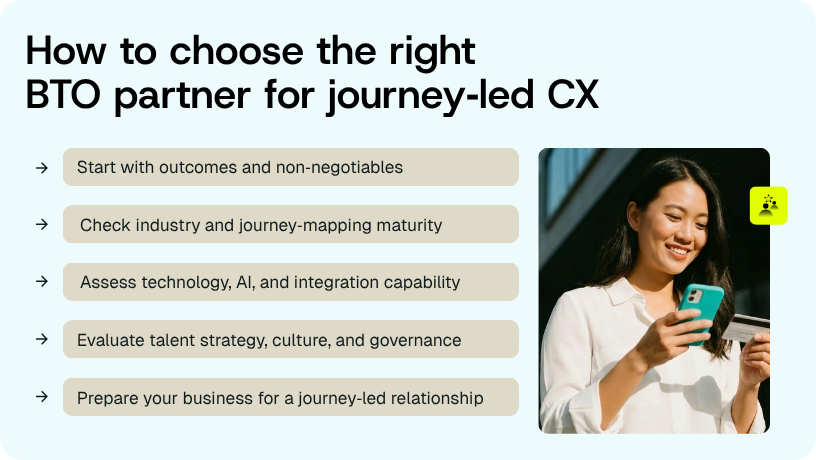
3. Assess technology, AI, and integration capability
A future‑ready BTO should bring cloud‑based contact‑center tech, strong CRM and QA integration, and production‑grade AI for routing, bots, agent‑assist, and journey analytics. Check how easily their stack plugs into your ecosystem, how data flows in both directions, and what guardrails they use for AI (governance, explainability, security, and compliance). The goal is a shared, data‑fed map, not isolated reports on their side.
4. Evaluate talent strategy, culture, and governance
Beyond tech, examine how they hire, develop, and retain specialists, and whether their culture can genuinely act as an extension of your brand. Look for low attrition in key roles, strong training and QA, and clear joint governance: who owns which stages of the journey, how decisions are made, and how issues that sit “between” organizations are escalated and resolved.
5. Prepare your own organization for a journey‑led relationship
Internally, nominate a cross‑functional core team (CX, product, operations, data, legal) that will co‑own the map with the BTO partner and make decisions at speed. Consolidate your existing documentation, SOPs, and interaction data, so discovery does not start from a blank page. Then agree upfront that journey maps will be living assets, reviewed whenever products, policies, channels, or AI models change, not just when a contract is renewed.
Mapping with BPO vs. BTO
Customer journey mapping has been around for years, but it has rarely been as effective as it can be today when combined with a transformation‑focused BTO model. Traditional BPOs could document what happens in service channels; BTO partners can now use the same maps as live blueprints that orchestrate people, AI, and processes across the entire customer lifecycle.
Here’s how that shift from BPO to BTO shows up in the way journeys are mapped and managed in practice:
| Aspect | Mapping with BPO | Mapping with BTO |
| Primary focus | Point solutions (bots, WFM, QA) are used mainly for efficiency | End‑to‑end business outcomes, CX, cost, and growth |
| Role of journey map | Nice‑to‑have workshop artifact, used mainly at kickoff | Core operating blueprint reviewed in governance and QBRs |
| Scope of journeys | Selected service interactions (calls, chats, tickets) | Full lifecycle journeys across marketing, product, CX, and ops |
| Ownership | Staffing, channels, and SLAs for service delivery | Joint ownership; clear client/BTO decision rights by stage/touchpoint |
| Level of detail | Channels, volumes, SLAs, basic pain points | Personas, goals, emotions, SLAs, tech, AI, governance, P&L links |
| Tech and data integration | Reporting by channel and queue | Integrated CX, CRM, analytics, and AI stack feeding one shared map |
| Role of AI | Point solutions (bots, WFM, QA) used mainly for efficiency | AI embedded as a “talent” in the journey (routing, design, analytics) |
| Change and experimentation | Ad‑hoc improvements, often ticket‑driven | Structured backlog of experiments prioritized from the journey map |
| Commercial linkage | SLAs and penalties tied to volumes and service metrics | Contracts and KPIs tied to journey outcomes and transformation goals |
| Strategic positioning | External contact‑center vendor | Transformation partner and co‑architect of the CX operating model |
A Four‑Talent BTO Model to Run Journey‑Led CX
Conectys is a simple, real‑world example of what a working BTO model looks like in practice. Our company offers a delivery model that can flexibly engage CX experts, global gig talent, EoR‑based teams, and native AI to support scale and efficiency. The customer journey map sits at the center of this model, showing where people need to stay in the loop and where AI solutions can safely take over, so every change in volume, complexity, or risk is matched with the right mix of human and machine.

Conclusion: Why Customer Journey Mapping in BTO Becomes a Management System
Most organizations now accept that customer journey mapping matters. Yet the competitive gap is between those who draw the paths and those who actually run their business on them.
Considering customer journey mapping in BTO projects, that difference shows up in very practical ways: how fast you can spot friction, how precisely you can direct AI and human talent, and how credibly you can defend CX investments in front of a CFO.
When your map is wired into real data, a modern AI‑heavy tech stack, and shared governance with your provider, it stops being a facilitation artifact and becomes a management system. It tells you not only where people struggle, but which queue, model, script, policy, or contract term you must change next, and what that will do to churn, CSAT, and cost‑to‑serve.
That is the real promise of customer journey mapping in BTO: a single, evolving story of your customers’ lives with your brand that can be read by humans, executed by AI, monitored by operations, and trusted by finance. The organizations that learn to operate from that shared story will not just “do CX better”. They will compound small improvements into a durable advantage in how they grow, automate, and partner.
Ready to transform with outsourcing?
Talk to Conectys about building customer journeys that improve CX, reduce friction, and scale with your business.