AT A GLANCE
This is the real story behind “legacy outsourcing is breaking.” The economics, structures, and expectations have all shifted at the same time, exposing the limits of legacy BPO outsourcing models. Business Transformation Outsourcing (BTO) is a game‑changer, an approach better aligned with how work, technology, and risk actually look in 2026, turning cost‑center outsourcing into a shared growth engine and loyalty driver.
Key Points
Legacy BPO is breaking in 2026 after decades of relying on labor arbitrage, static SLAs, and lift‑and‑shift capacity.
BTO replaces FTE‑based, volume‑focused outsourcing with outcome‑based, automation‑first partnerships.
Transformation means leveraging AI, hybrid global delivery, and putting outcomes at the center of every outsourcing decision.
Introduction
In global outsourcing, the game was simple for decades. Whether it was for customer support, call‑center build‑outs, technical assistance, or content moderation, the playbook remained largely the same. You copied a process to a cost‑friendly location, signed an FTE contract, skimmed the SLA deck once a quarter, and added people when things got busy. All while calling the entire undertaking “delegated” and “under control.” That is the legacy BPO outsourcing model in a nutshell, the one that hits a hard wall in 2026.
Today, that approach is being decisively pushed aside by a faster, sharper, and far more intelligent successor: Business Transformation Outsourcing (BTO). It is a strategy built on performance leverage, integrated AI, and outcome‑based outsourcing partnerships, in which teams rebuild core workflows rather than feeding outdated collaboration structures with additional headcount.
BPO: The Hero of a Previous Era
Yet, that does not mean BPO was a mistake. For more than 20 years, it has been a powerful model that has helped global brands prosper, grow, and expand without having to build everything in‑house. It unlocked follow‑the‑sun support and turned regions like Eastern Europe, India, the Philippines, and Latin America into service powerhouses. Millions of people owe their careers to BPO, including learning foreign languages, understanding international standards, and working across cultures.
And by 2025, BPO was still a giant in its own right. According to Mordor Intelligence, the global Business Process Outsourcing market was estimated at around $406.34 billion. In just a decade, it ballooned from under $100 billion in 2015, according to an Ovum forecast, effectively quadrupling.
From Outsourcing Muscle to Transformation Brain
However, in 2026, a different beast begins to grow in importance. The previously mentioned BTO is better equipped to lead in a world shaped by AI, constant change and outcome-driven decisions. It has the almost magical capability to turn routine operational work into a strategic driver of business growth.
Today, we can think of BPO as a well-deserved hero of a previous era, now gradually stepping back and making room for true Business Transformation Outsourcing to take the stage and thrive in the exciting times ahead.

What Legacy Outsourcing Is in Practice
Before we zoom in on where things break in particular, it helps to be even clearer about what we are actually talking about when we say “legacy outsourcing.” It is the model most global brands grew up with and turned to when back‑stage tasks started piling up. Customer queries, billing issues, technical questions, and content to review were skyrocketing, and handling everything internally was unsustainable.
Lift‑And‑Shift Under a Different Cost Structure
The quickest way to cope was to relocate the work elsewhere, nearby, nearshore, or far away. Companies simply reproduced familiar workflows under a different cost structure, which is a classic lift‑and‑shift outsourcing move, all without really questioning what they should look like in the first place.
From Simple Fix to Complex Operating Model
Over time, the processes became more layered. Operations spread across regions, languages, and time zones. Vendors added more solutions, from basic customer care to finance, HR, and content moderation. Contracts evolved from pure volume and service levels built around an FTE‑based outsourcing model to include hints of “outcome” language in certain areas. On the surface, the model looked mature, nuanced, and strategic, and for a long time, it genuinely was.
Efficiency Without Reinvention
Yet one thing stayed remarkably stable: the processes themselves were treated as a given. The job of the outsourcing partner was only to keep things running smoothly, not to ask whether it still made sense. Success was defined by how reliably the machine turned, how many interactions it could process, and how efficiently it could absorb growth. Deeper questions, such as “Is this the right journey, the right experience, the right use of technology?” were often left untouched.
This is why we call it “legacy” today. Not because it never improved, but because it was built for a world where stability, predictability, and labor arbitrage were the main constraints, and copying a process to a cheaper location was enough. Nevertheless, a 400‑billion‑plus‑dollar industry built on labor arbitrage, static service levels, and copy‑paste processes could not last forever.
How Legacy BPO Fails in Real Life
To see where the traditional model really breaks, you have to follow the work from trigger to outcome, not just read the SLA deck. On paper, legacy outsourcing across CX, back office, finance operations, HR services, and Trust & Safety looks reassuring: clear contracts, defined SLAs, and detailed process documentation that promise predictability and scale. In practice, when you walk a real customer, claim, or risk case through the system, the cracks become impossible to ignore, especially in a 2026 world shaped by AI, new regulations, and board‑level scrutiny of operations.
This is why legacy BPO models, designed for a world of cheap labor, stable processes, and basic SLA reporting, are now starting to break under the combined pressure of AI, regulation, and rising CX expectations.
The Process Looks “Green” on Slides, but Broken in the Journey
In the contract, everything is “in scope,” “green,” and “delivered on time.” Inside the operation, cases bounce between queues, channels, and teams, with no single owner of the end‑to‑end result. Customers repeat the same information multiple times, agents re‑key data across different systems, and exceptions sit in limbo because they fall between process swimlanes. Success reports celebrate handling time and volume, while what really matters, first‑time resolution, customer effort, trust, accuracy, and regulatory comfort, steadily erodes.

Labor Arbitrage Runs Out of Road
For years, the default fix was straightforward: hire more people. More agents for peak season, more processors for backlog, more QA for rising volume, more supervisors for new lines of business. Beyond a certain scale, this lever reverses: complexity, inconsistency, and burnout grow faster than outcomes improve, and unit cost savings are eaten by rework and oversight. Training becomes a permanent firefight. Every new product, policy, or exception path makes it harder to deliver a consistent, brand‑safe and regulator‑ready experience, precisely as AI and automation make “cheap, manual volume” less defensible.
Operations Are Disconnected from Strategy
In the old model, outsourced work is something you “hand off” so that product, finance, risk, and growth teams can focus elsewhere. The unintended side effect is that the richest insights into customers and risk reside in someone else’s systems. Escalations, complaints, exceptions, friction points, and frontline fixes are trapped in tickets, transcripts, and spreadsheets. The BPO stays “within scope,” but its data rarely shapes pricing, product, risk models, or experience design, even as AI‑driven analytics make it easier than ever to connect operational signals to business outcomes.
“Non‑Core” Work Quietly Reshapes Brand and Risk
Most outsourced flows are still labeled “non‑core”: support queues, content review, back‑office checks, simple verifications, document processing. In reality, this is where your brand earns or loses the right to grow, and where risk either stays under control or starts to drift. When these journeys are managed as low‑cost, low‑priority work, the impact shows up elsewhere: in churn, NPS, error and dispute rates, audit findings, press coverage, and the number of times your exec team hears, “We love your product, but your service and operations…”. In regulated, AI‑intensive environments, those weak links quickly become board‑level issues.
Change Arrives, the Model Freezes
New regulations, new products, AI‑driven volume spikes, fresh fraud patterns, and sudden shifts in customer behavior all demand fast, confident process changes. Legacy BPO is optimized for stability and repeatability, not continuous redesign. Every improvement turns into a mini‑project, every policy tweak becomes a long change request, and every automation idea runs into contractual boundaries. While your business moves in sprints, the operation moves in quarters, exactly the inverse of what AI‑driven, outcome‑based pricing and governance models now make possible.
Any real‑life threats on the radar? One of the clearest warning signs for legacy BPO comes from Gartner, which predicted that finance and accounting organizations would choose not to renew 60% of their existing BPO contracts by 2025 because traditional, headcount‑based pricing models fail to drive digitization and process improvement.
What Business Transformation Outsourcing Is
Business Transformation Outsourcing (BTO) is an outsourcing model built around change, not just execution. Where traditional BPO takes over an existing process and runs it efficiently at scale, BTO starts by asking whether that process should exist in its current form at all.
In a BTO model, you do not just buy capacity or headcount. You bring in a partner to redesign how work is done, using data, AI‑driven automation and managed automation to remove unnecessary steps, reduce effort, and improve outcomes such as resolution time, NPS, churn, safety, and cash flow. Instead of treating outsourcing as a back‑office cost lever, BTO turns those same workflows into a growth engine by organizing them around outcomes, automation, and shared upside. The scope includes running day‑to‑day operations and continuously tuning workflows, tools, and policies as your products, customers, and regulations evolve.
Change Baked into the Contract
BTO assumes that your environment will keep changing and bakes that into the relationship: how it is governed, how it gets paid, and how risk and upside are shared. It keeps the global reach and operational muscle that BPO built. Still, it rewires the engine so that adaptability, insight, and outcomes sit at the center of the model, not bolted on around the edges.

FAQ
Legacy Outsourcing vs. BTO / 2026, In One View
Put simply, legacy BPO outsourcing buys capacity, while Business Transformation Outsourcing buys leverage. Capacity gives you more hands to run yesterday’s process. Leverage redesigns the work around outcomes, automation, and shared upside. The shift looks like this when you compare the two side by side.
| Legacy outsourcing model (classic BPO) | BTO / 2026 model (Business Transformation Outsourcing) |
| FTE‑based, rate‑card pricing focused on hours and roles. | Outcome‑based outsourcing model, often with gain‑share or pay‑for‑performance tied to business metrics (CSAT, churn, risk, cash flow). |
| “Lift‑and‑shift” of existing processes to cheaper locations. | Process redesign first, then managed automation and AI integration wrapped around a new operating model. |
| Many low‑cost vendors per function (“vendor zoo”) are managed as interchangeable suppliers. | Fewer, deeper, platform‑like partners with reference architectures, reusable playbooks, and embedded analytics. |
| Labor arbitrage is the primary source of value. | Operating leverage from automation, speed, resilience, accuracy, and compliance, not just wage differentials. |
| Focus on volume metrics (AHT, tickets handled, items reviewed) and SLA compliance. | Focus on business outcomes: resolution, NPS, churn, error and dispute rates, safety incidents, and regulatory comfort. |
| Outsourcing is treated as a commodity service that keeps working “off the plate”. | Partner treated as a strategic extension of the core, shaping product, pricing, risk, and customer experience. |
| Manual, human‑heavy workflows with tools layered on top. | AI‑assisted, automation‑first, human‑in‑the‑loop workflows designed for explainability and auditability. |
| Offshoring as default, integration and data sharing as afterthoughts. | Hybrid global delivery designed around value, risk, and fit, with deep integration into your tech stack and data flows. |
In that sense, BTO is less a rebrand and more an answer to how outsourcing actually creates value in an AI‑first, regulated world: the metric becomes the contract, and providers win only when the client’s business truly wins. Outcome‑based metrics, automation, and human‑in‑the‑loop design make it feasible to price and govern based on impact rather than volume.
What Business Transformation Outsourcing Changes in Practice
So far, we’ve looked at why legacy models crack and what BTO is in theory. To really feel the difference, it helps to follow a real story rather than a generic SLA.
A Gaming Launch, Not a Slide
One recent Conectys gaming launch showed how BTO‑style CX outsourcing looks from the outside. A fantasy league around a major tournament was going live in multiple countries, with millions of users, intense peak times, and live user‑generated content. There was no time to build a classic “BPO floor.”
Instead, Conectys switched on gig moderators in key markets, plugged in AI to filter obvious spam and rule‑breaking content, and kept experienced CX specialists on the line for VIP players and tricky edge cases.
Within three weeks, the client went from zero to full multilingual coverage, a true BTO model in motion, not just another FTE contract.

Inside the Four‑Talent Operating Model
This was possible thanks to Conectys’ Four‑Talent Operating Model, a real BTO engine that combines human expertise and native technology working in harmony in diverse, elastic configurations. Together, they make a huge difference, enabling demanding brands to achieve far more than was ever possible with traditional CX BPO and content moderation outsourcing.
How To Start the Shift (Without Blowing Up the House)
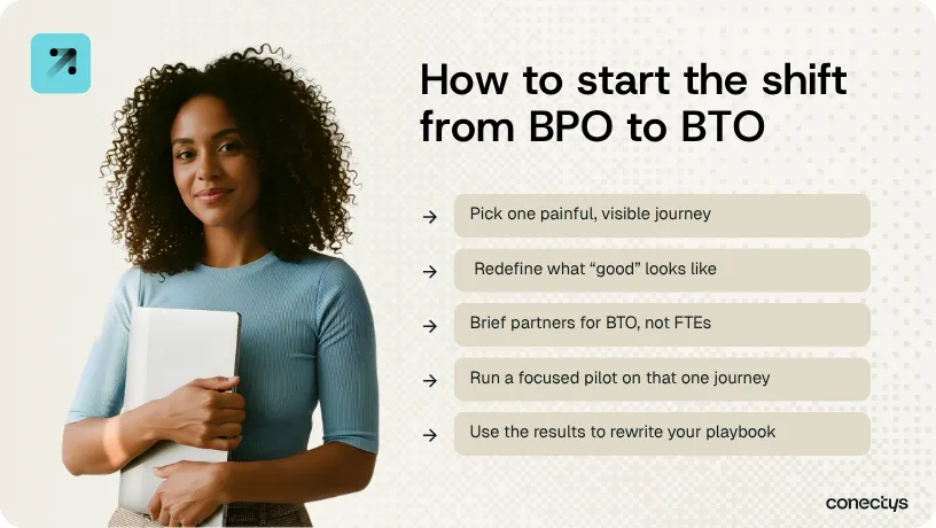
Seeing the gap between legacy BPO and Business Transformation Outsourcing is one thing, while acting on it is another. You do not have to rewrite every contract at once. The safest way to begin is to treat the new approach like a controlled experiment: choose one journey, prove that a different way of working delivers better outcomes, and then expand from there. This is how you start moving from BPO to BTO without blowing up the house.
Here are a few recommendations on how to turn that idea into action:
1. Pick one painful, visible journey
Choose a flow where the old model obviously hurts: a core CX journey (orders, billing, cancellations), a Trust & Safety stream under regulatory or PR pressure, or a high‑volume back‑office process like KYC, claims, or refunds. Make sure leaders already feel the delays, errors, and complaints.
2. Redefine what “good” looks like
Do not stop at “calls answered” or “tickets processed.” Write down the outcomes that really matter for that journey: CSAT or NPS, time‑to‑resolve and first‑time resolution, error and dispute rates, safety incidents and escalations, and cost per successful transaction rather than cost per contact. These will be your north star.
3. Brief partners for BTO, not FTEs
When you talk to current or potential suppliers, avoid “how many FTEs at what rate?”. Ask them to show how they would redesign the workflow, where AI and automation would fit, how they would plug into your existing stack, and which outcomes they are willing to stand behind commercially. If they mostly talk about seats, shifts, and SLAs, you are still in legacy land.
4. Run a focused pilot on that one journey
Once you have a credible BTO‑style design, launch a limited‑scope pilot. Baseline your chosen metrics, run the new model, and track the same indicators weekly on a shared dashboard. Give it enough time to redesign, test, and stabilize, and treat it as a real experiment with clear hypotheses, not a fuzzy “phase one.”
5. Use the results to rewrite your playbook
If the pilot delivers better outcomes, lower risk, or more resilience, treat that as your proof point. Use it to renegotiate other contracts, consolidate overlapping vendors, and extend the BTO approach into adjacent journeys. You are not chasing a one‑off efficiency win. You are changing what you buy when you outsource, from cheap capacity that props up old processes to operating leverage that makes the whole system better.
How to Differentiate Whether BTO Is Real or Just a Rebrand
Once you have seen how a BTO‑style outsourcing pilot behaves in real life, the deeper question is whether BTO is genuinely a new model or just a fresh label on the same engine. If legacy outsourcing is the model that keeps old playbooks running, Business Transformation Outsourcing is the approach that assumes those playbooks must change.
In that sense, BTO is a powerful response to many of the hurdles baked into classic BPO, including rigid processes, volume‑only thinking, and a habit of treating “non‑core” work as invisible. But it only works when it truly reshapes processes, metrics, and incentives, not just the wording on the contract.
BTO Is Powerful, But Not Risk‑Free
However, it is essential to understand that BTO is not a cure‑all. The same structure that concentrates more value and impact in each relationship also increases your dependency on a smaller pool of partners. If you choose poorly, don’t properly set the incentives, or under‑specify the outcomes, the damage can be more serious than with a traditional, interchangeable BPO vendor.
Outcome‑based pricing also requires brutal clarity on baselines, attribution, and data quality. If you cannot agree on what “good” looks like and how to measure it, you will spend more time debating dashboards than improving journeys. There is also a cultural and governance shift on the client side. A BTO model demands deeper access to your systems and data, faster decision‑making on change requests, and more senior time spent in joint steering, rather than relying solely on quarterly vendor reviews.
That is why the safest way to adopt it is through focused pilots, clear guardrails, and exit options, treating BTO as a managed experiment before you let it reconfigure your entire operating model. Used this way, BTO becomes a way to de‑risk change, not just a more sophisticated way to buy capacity.
How To Find the Right Partner For BTO
Most outsourcers say they are “transformational.” Only a few really are. Some are still firmly in the old BPO world. Others are halfway there, adding a bit of AI on top of the same FTE engine. Your job as a modern client is to tell the difference and raise the bar on what you buy.
Imagine your first conversation. Do potential partners start by asking how many seats you need and which languages, or do they ask what business outcomes you want to move? True BTO outsourcing players talk first about outcomes and operating models, then show how they would measure success before they mention “24/7 coverage” or rate cards. They naturally use words like retention, accuracy, safety, speed, and compliance, and they can tell real stories about the journeys they redesigned, not just the floors they staffed.

Tech That’s Built into the Model, not Bolted On
Their relationship with automation and AI is another big clue. A genuine BTO partner treats AI as part of the core model, not a shiny add‑on. They can point to specific steps they already automate, explain how they prepare data and configure models, where guardrails sit, and how humans stay in the loop on high‑risk decisions. They talk about managed automation as a living layer they own and improve, not just “we have a chatbot.”
Integration is just as important as operations. The right partner is comfortable plugging into your CRM, ticketing, ERP, and platform APIs and providing you with shared, real‑time dashboards on the outcomes you care about. They sit with your security, legal, and risk teams to keep data and compliance aligned. If the default is monthly PDFs and siloed tools, you are still looking at yesterday’s BPO mindset.
Beyond Destinations: How They Really Run
Finally, look past locations to the operating model and mindset. Footprint matters, but design matters more. A BTO‑ready partner can mix different types of talent, such as specialists, automation, and flexible capacity, under one governance framework, and show a track record of continuous improvement instead of long, static contracts.
Providers that feel more like product or platform‑like outsourcing partners, with reference architectures, reusable playbooks, and embedded analytics, are usually closer to true Business Transformation Outsourcing than pure staffing firms. Use your first pilot to test this: see whether they bring insights and change ideas unprompted, surface risks early, and frame automation as a shared opportunity, not just hit SLAs and protect their hours.
Conclusion
In 2026, legacy outsourcing is not collapsing because it suddenly “stopped working”, but because the work around it changed faster than the model did. AI, regulation, and customer expectations have stripped out the easy tasks and left behind journeys where design, accountability, and adaptation matter more than raw headcount. In that world, copying yesterday’s process to a cheaper location is no longer a strategy. It is a liability with a time delay.
That is why legacy BPO outsourcing is breaking down in 2026, and why models like Business Transformation Outsourcing (BTO), built around AI, regulatory readiness, and real‑time CX, are redefining what outsourcing can do for growth. Business Transformation Outsourcing exists to close that gap. It keeps the global reach BPO pioneered but rewires it around outcomes, managed automation, and partners who treat “non‑core” work as brand‑ and risk‑critical. When you make that shift from BPO to BTO, you give yourself a model that can actually keep up with 2026.
The next step is to choose where you will run your first transformation, which parts of your operation it should truly enhance, and which partner you trust to help you redesign the work so you can grow at full speed.
If you are ready to move beyond “more capacity”, pick one critical journey and contact Conectys to redesign it with you around shared outcomes, not just SLAs.