
AT A GLANCE
Content moderation is no longer just about keeping games from going wrong. It now helps decide which games succeed and which disappear. In a world where billions of players connect, and toxicity spreads fast, smart studios treat oversight as core game design, not damage control. In the end, moderation not only saves the game, but also makes it better. It often makes the game worth playing.
Introduction
Gaming content moderation is no longer about simply “stopping the worst”. It is a design choice that decides who stays, who pays, and what your game is known for six months after launch. Simply put, it has quietly become one of the strongest levers community managers have over player experience, retention, and brand safety.
Communities do not become toxic by accident. They get that way when teams treat oversight as a patch rather than a pillar. The real shift is seeing in-game moderation as part of system design, not just support. You plan for it in mechanics, messaging, and workflows, rather than bolt it on once problems surface.
When you treat it this way, you not only reduce harm but also prevent it. Consequently, this helps shape who feels welcome, how long they stay, and how confident partners are willing to attach their brands to your world.
In this guide, you will see how gaming content moderation should really look in 2026: not a mute button for bad actors, but a design decision that quietly shapes who shows up, who stays, and what your game is famous, or infamous, for.
What is Gaming Content Moderation?
Gaming content moderation is the invisible infrastructure that lets players go all‑in on the game. They can play without worrying about what waits in chat, in their DMs, or in the next lobby. In other words, it is the organised effort to monitor, assess, and act on user‑generated content and behaviour. The goal is to keep the experience safe, fair, and on‑brand without killing the fun. This especially matters for everyday gaming enthusiasts, and becomes critical in always‑on multiplayer titles, where threats sit right alongside the excitement.

At its core, gaming moderation covers everything players say, do, and create in and around each session. That includes text and voice chat, usernames and profiles, user‑generated content, cosmetics, and in‑game behaviour. Community management sits next to it but is not the same job: they build culture, hype, and trust, while moderators reduce harm and handle the messy edge cases that land in the reports’ queue.
Done well, in‑game moderation creates a space where players feel safe enough to play hard, banter, and compete without wondering whether the next match will include slurs, stalking, or a phishing link disguised as a “free skins” invite: no threats, no drama, no scandals, just a pure play experience.
Global content moderation is now a multibillion‑dollar, high‑growth market, with gaming one of its fastest‑moving segments. Gaming and esports sit among the quickest‑growing end‑user sectors, with moderate spending in this category forecast to rise at about 17.6% CAGR as publishers link safety directly to retention and monetisation. Live‑stream and voice moderation is the fastest‑expanding content type, with a CAGR of around 18.9%, driven by multiplayer titles, social audio, and metaverse‑style events. (Mordor Intelligence)
Why Gaming Content Moderation Matters
As the online gaming market becomes more crowded and competitive, new challenges and risks continue to emerge. This expanding landscape does not just deliver fresh maps and modes.
It also amplifies the darker side of play. Hate, scams, and abusive content can directly affect players, degrade community quality, and harm companies if teams do not handle them properly.
The global online gaming market is projected to more than double from USD 257 billion in 2025 to over USD 512 billion by 2034, with annual growth of almost 8%.
(Precedence Research)
More than 3.3 billion people worldwide now play video games, with the player base growing by over 1 billion in less than a decade.
(Exploiding Topics)
More than a third of gamers have faced hate-based harassment, most commonly linked to ethnicity, gender, or sexual orientation.
(Frontiere)
Below are the key moderation challenges that online gaming platforms face as they scale.
Spreading Toxicity
Harassment, hate speech, griefing, and targeted abuse remain persistent problems across both competitive and social games. These behaviours drive player churn, disproportionately affect marginalised groups, and quietly undermine long‑term community health.
Evolving Language and Cultural Nuance
Player slang, coded language, and region‑specific expressions evolve rapidly. What looks harmless in isolation may carry a very different meaning in context, making detection and enforcement increasingly complex, particularly for global titles serving multiple cultures at once.
Voice Chat and Live Communication
Voice Chat and Live Communication
The growing use of real‑time voice communication introduces a different class of moderation challenges. Such content is harder to monitor, depends on accurate speech‑to‑text and language handling, and often demands near‑real‑time intervention to prevent harm while a match is still in progress.
Scams and Social Engineering
Fraud, phishing attempts, and impersonation schemes are increasingly woven into gameplay loops and social features. These scams can lead to financial losses, account takeovers, and a broader erosion of player trust in the platform.
Scale and Speed of Interactions
Popular games generate vast numbers of interactions every minute across chat, voice, matchmaking, and user‑generated content. Moderation systems have to keep up with this volume without sacrificing accuracy, consistency, or perceived fairness, especially during peak events and major launches.
Regulatory and Reputational Risk
Governments and regulators are putting online safety under greater scrutiny, particularly where minors are involved. Failing to moderate effectively now carries legal exposure, potential platform sanctions, and long‑term brand damage that can outweigh short‑term growth.
From Challenges to Strategy
To respond effectively, entertainment studios need to build moderation strategies that operate at scale and real speed, focusing on the most complex dangers and hottest threat areas, from live chat and voice channels to competitive matchmaking and player‑driven economies. The right mix of approaches, processes, and tools keeps player safety, in‑game experience, brand reputation, and revenue aligned instead of pulling in different directions.
Overall, strong community management and in‑game moderation help new players become regulars, keep veterans engaged, and give partners confidence that your game is a safe home for their brand.The growing use of real‑time voice communication introduces a different class of moderation challenges. Such content is harder to monitor, depends on accurate speech‑to‑text and language handling, and often demands near‑real‑time intervention to prevent harm while a match is still in progress.
Types of In-game Moderation
Modern in‑game moderation is no longer just about muting bad actors in chat. It is an ecosystem of tools and teams that monitor what players say, show, and do across the entire title, from the first lobby to the final post‑match screen. To keep pace with 2026‑level scale and risk, studios are leaning on four main approaches, each targeting a different part of the player’s journey.
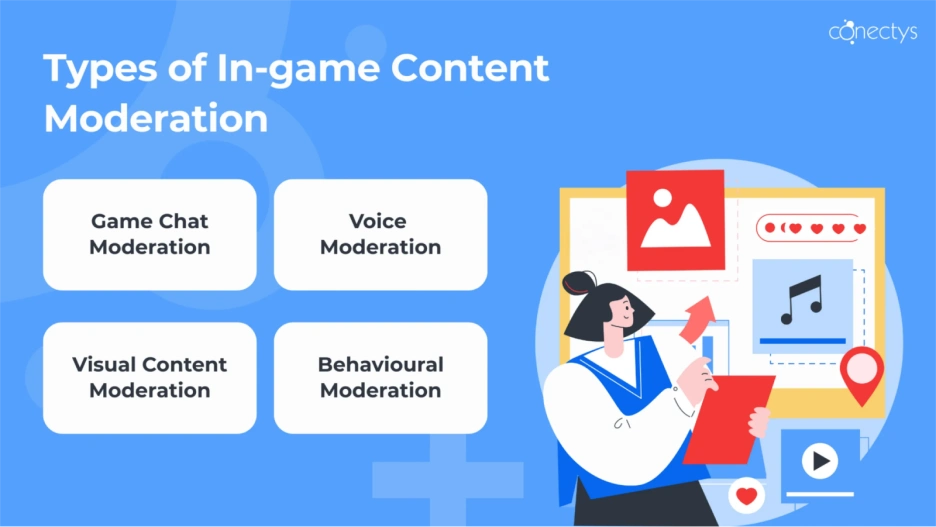
Game Chat Moderation
Game chat moderation is still the frontline. Text chat is the most visible and persistent surface for abuse, spam, scams, and hate speech, and it can shape how a lobby feels in seconds. Modern teams combine rule‑based filters with language models that understand slang, context, and multiple languages, blocking obvious slurs and scam links without over‑policing friendly banter.
The priority is real‑time detection and removal: muting, warning, or escalating when needed, while avoiding a wall of censored messages that makes the space feel cold or broken. AI systems triage routine cases at speed, with human moderators stepping in where nuance, intent, or cultural context could change the decision.
Voice Moderation
Game voice moderation is the most demanding sibling. Voice chat is spontaneous, emotional, and hard to review after the fact, yet it is a major vector for harassment, grooming, and real‑world safety risks. AI‑driven transcription and analysis now let companies scan live or near‑live audio for slurs, threats, and grooming indicators, trigger temporary mutes or warnings, and send the worst incidents to human reviewers without forcing people to listen to every second of audio.
The goal is a transparent system where players know their voices are monitored, serious abuse is caught, and competitive play can continue without the constant fear of open mics. In practice, that means pairing AI detection with clear policies, appeal routes, and trained reviewers who understand tone, culture, and context.
Visual Content Moderation
Visual UGC in games is exploding, covering avatars, profile pictures, banners, skins, emblems, screenshots, and in‑game billboards, all of which carry significant reputational and legal risk. Multimodal tools scan images and video for sexual content, hate symbols, deepfakes, and illegal material before or just after they go live, often using hashing and matching to recognise previously banned or known illegal assets.
High‑risk or ambiguous content is routed to trained human moderators who can tell when a symbol or image is genuinely harmful versus educational, parodic, or reclaimed, so enforcement stays accurate and defensible. Always‑on specialists can also monitor live streams, esports events, and high‑visibility moments, providing instant flagging and crisis response when something slips through the cracks.
Behavioural Moderation
Behavioural moderation looks at how players act, not only what they say. Soft griefing, such as AFK farming, queue dodging, or deliberately throwing matches, rarely fits a single clear rule-breaking criterion, but over time it undermines competitive integrity and drives players away.
Modern systems correlate gameplay signals (suspicious performance swings, repeated early exits, unusual movement suggesting cheating) with social signals, such as recurring reports across matches, to identify disruptive patterns.
Automated detection surfaces the cases, while player reports add context, feeding tiered responses that range from gentle nudges and temporary restrictions through to ranked lockouts and permanent bans for repeat abusers. Leading brands now tie these systems into broader safety programmes: tailored moderation strategies, robust player reporting, identity and fraud checks, periodic security audits, and reward structures that actively spotlight positive behaviour rather than only punishing the worst.
Moderation Approaches: AI, Human, and Hybrid
Before diving deeper into moderation strategy, it is important to recognise that most modern setups are built on three core approaches: AI‑driven systems, human review, and hybrid workflows that combine the two. The strongest programmes treat them as complementary, not competing, and design workflows so that each plays to its strengths.
AI‑driven Moderation
AI systems scan huge volumes of player activity, including text chat, voice transcripts, gameplay signals, and report patterns, to spot likely violations in near real time. Techniques such as natural language processing, speech‑to‑text, image analysis, and behavioural modelling let them catch toxic language, harassment, cheating, and coordinated abuse at a scale no human team can match.
Their edge is speed and coverage: AI can monitor millions of interactions simultaneously and act in seconds, which is vital in always‑on, global environments. But it is still probabilistic rather than confident, and can misread humour, reclaimed slurs, role‑play, or context‑specific language, especially as player slang evolves.
In practice, that makes AI best suited to triage, prioritisation, and clear‑cut enforcement, not to final judgement in sensitive or ambiguous cases.
The AI content moderation market was worth about USD 1.5 billion in 2024 and could grow to around USD 6.8 billion by 2033. (Verified Market Reports & Data Intelo)
Human‑led Moderation
Human moderators add what machines cannot: contextual judgement, cultural insight, and empathy. They handle edge cases, appeals, and incidents where intent and impact are hard to untangle, and they are usually the first to notice new griefing tactics, coded insults, or subtle harassment patterns that tools have not yet learned to recognise.
The cost is that human‑only coverage does not scale easily. Round‑the‑clock, multilingual support is expensive, and constant exposure to disturbing content is demanding work unless teams have strong tooling, clear policies, and proper well-being support. Any serious safety setup has to be sustainable for the people doing the job, not just efficient on paper.
Hybrid Moderation Models
Hybrid models combine the two. Automated systems continuously flag, score, and sort activity, handling high‑volume, low‑ambiguity issues like spam and obvious slurs, while human moderators focus on the cases where nuance, severity, or visibility make the decision more consequential. Over time, the decisions humans take feed back into the models, improving accuracy and reducing blind spots.
Done well, this approach keeps enforcement consistent without becoming rigid, letting platforms adapt as communities and threats change. It is also what makes the earlier layers work together as one coherent safety system rather than a set of disconnected tools.
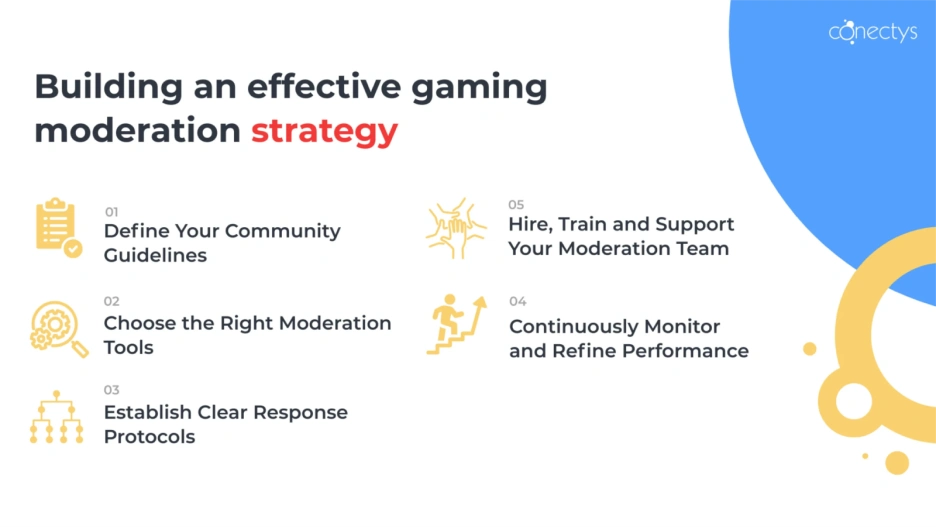
Building an effective gaming moderation strategy
Once you know what you are moderating and how your tools work, the final step is turning all of that into a deliberate strategy. That means deciding what you stand for as a game, how you enforce it, and who you trust to keep it running at scale.
1. Define Your Community Guidelines
Moderation without clear rules quickly turns into arbitrary policing. Your first strategic move is to define what “good” looks like for your title, not just what is forbidden by law, spelling out unacceptable content and behaviour, such as harassment, hate, cheating, impersonation, doxxing, extremism, and illegal material, in language your players actually recognise.
Guidelines should reflect your audience and rating; a 13+ sandbox needs different guardrails from an 18+ hardcore shooter. They also need to be visible in all the places where decisions are made, covering onboarding, patch notes, live events, report flows, rather than buried in a legal page that nobody reads until something goes wrong.
2. Choose the Right Moderation Tools
You do not need every shiny product on the expo floor, but you do need a coherent stack that fits your design, scale, and risk profile. Platform-native tools on consoles, mobile devices, PCs, and social hubs like Discord or Steam provide a baseline for reporting and controls. Yet, they are rarely enough for games built around intense social interaction.
On top of that, most studios layer specialist solutions for AI chat filtering, voice analysis, image and video screening, and behavioural detection, often tying them into telemetry, anti‑cheat, and CRM systems. The point is not to collect tools for their own sake, but to build a moderation framework your team can realistically operate, measure, and improve over time.
3. Establish Clear Response Protocols
Consistency is often what separates “fair enforcement” from “the mods hate me”. Response protocols protect your team from decision fatigue and your brand from accusations of bias by defining how you deal with first‑time versus repeat offenders, which behaviours trigger temporary restrictions, and what pushes a case into a permanent ban.
Appeals sit inside the same system. Giving players a simple way to contest decisions, and responding with human explanations rather than stock phrases, can do as much for trust as the original enforcement. Summaries of enforcement trends, anonymised case examples, or regular safety updates help the community understand where the line is and why it is being held.
4. Hire, Train and Support Your Moderation Team
Even with sophisticated automation, human moderators remain at the heart of your programme. You need to find skilled reviewers who bring strong game literacy. They must be familiar with your meta and in-game slang and have a solid understanding of platform policies. Just as importantly, they need cultural competence, so they can recognise how harassment and offence manifest differently across regions, communities, and identities.
Alongside core in‑house staff, many organisations also rely on vetted gig workers to handle overflow queues or cover specific time zones and languages. To make that sustainable, you still need clear guidelines, structured training, and quality checks, so flexible capacity does not turn into inconsistent enforcement.
And remember, your Trust and Safety teams also need serious institutional support. That means sensible workloads, tooling that masks or blurs the most distressing content, regular rotation out of high-risk queues, and access to mental health resources. For community and trust leaders, this is not a nice-to-have HR initiative. It is the difference between a stable, high-judgement moderation team and a burnt-out group that cannot keep pace with the game.
5. Continuously Monitor and Refine Performance
A gaming moderation strategy is never “finished”. You need to track key signals, including report volume and closure time, repeat‑offender rates, ban appeals, player sentiment around safety, and correlations among safety metrics, retention, and revenue.
Regular reviews of these data points, along with qualitative feedback from players and moderators, should inform tuning thresholds, update rules, retrain AI models, and adjust staffing or workflows. This continuous loop turns moderation from a reactive firefight into an evolving system that improves alongside your game and community.
When to turn to a specialist moderation outsourcing partner
Specialist content moderation BPOs become crucial when your in‑house team can no longer cover the volume, languages, or risk profile of your game without burning out or missing critical incidents. They are most valuable at three moments: rapid scaling (launches, new regions, new platforms), high‑stakes live operations (esports, seasonal events, influencer campaigns), and when regulatory or brand risk demands more structure than your current setup can provide.
On the operational side, a strong partner can always bring always‑on multilingual moderation for chat, voice, and visual UGC, AI‑assisted queues and workflows, real‑time escalation for live events, and specialised review for edge cases such as self‑harm, grooming, or violent and extremist content. They can also add deep-fake and NSFW detection, fraud and scam monitoring, and “surge” capacity to handle a new season, patch, or promotion that suddenly drives volume beyond your usual baseline.
On the governance side, they help you turn good intentions into a concrete framework: drafting and maintaining practical community guidelines, mapping enforcement ladders, creating appeal and audit trails, and aligning your policies with regulations such as the DSA, COPPA, and GDPR in the markets you care about. The best partners do this in a way that matches your brand tone, risk appetite, and player promise, rather than imposing a generic one‑size‑fits‑all rulebook.
For most gaming companies, the sweet spot is a shared model: you keep ownership of vision, policies, and player experience, while the BPO supplies scale, specialist skills, and resilient operations. When that partnership is well designed, players see consistent, fair enforcement. Your internal teams can focus on product, design, and community, and the overall safety layer becomes a competitive advantage rather than just a cost of doing business.
Conclusion
Content moderation is no longer a reactive cost centre sitting at the edge of production. In modern online games, it has to be part of the system design. The studios that handle toxicity well are not just stricter enforcers. They simply make early, deliberate choices, invest in people and tools, and treat player behaviour as something to be shaped rather than merely punished.
The real competitive advantage now lies in integration. Games that bake moderation into mechanics, workflows, and culture scale more safely, keep players longer, and avoid a constant cycle of crisis‑driven fixes.
For community leaders, the question is, therefore, no longer whether content moderation is necessary, but whether the game is built to support it. Those companies that get this right will not just moderate problems. They will grow stronger, more resilient player environments.
FAQ
Are you just another call center?
No. And we work very hard not to be.
Can you work with our existing tech stack?
Yes. And if it’s a mess, we’ll help fix that too.
Is AI replacing agents?
No. AI supports agents. Humans stay accountable. Always.
Do you scale fast?
Yes – without cutting corners or burning people out.


