Agentic AI is something you have probably heard about already, and if not, you will very soon. In CX, it is less a single moment and more a shift: customer experience finally gets a real operating system, not just another chatbot bolted onto the front of a legacy stack. It is the difference between adding a voice to your service and giving that service a brain that can think, decide, and act on its own, within the limits you choose to set.
Agentic AI in customer experience is a new breed of intelligent capability. On the surface, it may resemble yet another chatbot, but only when you look closer do you see how different it really is from the AI we’ve known so far. Dive deeper, and you find solutions that independently interpret objectives, determine the next best course of action, and coordinate activity across your technology ecosystem. This truly marks a shift from static, rule-based automation to adaptive decision-making.
For contact centers, it means providing faster, always‑on, context‑aware support at scale. And beyond the buzzwords, agentic AI is ruthlessly practical: it helps optimize spending by automating routine tasks while unlocking levels of personalization that would be impossible for human teams alone.
With all these benefits on the table, it’s no surprise that many analysts now see the rise of agentic AI as inevitable rather than a “nice to have.” By 2029, Gartner estimates that agentic AI could autonomously resolve around 80 percent of common customer service issues under the right conditions, driving roughly a 30 percent reduction in costs. If you can meet the data, integration, and governance requirements behind that scenario, your baseline for routine support could look very different from today.
Simply put, agentic AI will increasingly disrupt how companies deliver customer experience and redefine how they manage interactions from first contact to resolution. If this is what support could look like for well‑prepared organizations in a few years, the real question is how you want to position yourself on that curve.
In the rest of this article, we’ll break down what agentic AI really is, where it rewrites the old rules of CX, and how to start experimenting without putting your entire contact centre at risk.
What Is Agentic AI in Practice, and How Is It Different?
Agentic AI is like AI’s younger, more capable sibling in the artificial intelligence family, the one that actually gets things done. Unlike traditional chatbots or advanced generative AI, which focus on producing content or responding to inquiries, agentic AI takes autonomous action. It reasons, plans, interacts with tools and APIs, and executes multi-step processes to resolve inbound issues end-to-end, all while staying within the guardrails you define.
From Simple Tickets to Smart Autonomy
In customer experience, this applies mainly to relatively simple, transactional queries such as user authentication, system updates, bill payments, orders, refunds, plan details, or straightforward escalations. These are exactly the types of repetitive, rules-based tasks agentic AI handles efficiently.
According to McKinsey’s analysis of millions of contact center cases, these common tickets account for around 50 to 60 percent of brand–consumer interactions, even as overall complexity has increased. Automation in this area is where agentic AI can make the most immediate, visible difference in both cost and experience.
The table below highlights the key differences across core AI functions in customer service:
Capability
Traditional chatbot
Generative AI
Agentic AI
Follows scripts
✅ Rule-based flows
❌ Freeform replies
❌ Goal-driven behavior
Generates natural language
❌ Templates only
✅ Fluent, contextual
✅ Fluent, contextual
Makes decisions autonomously
❌ Fixed logic
❌ Needs orchestration
✅ Policy-bound decisions
Executes multi-step tasks
❌ Single step
Limited (via plugins)
✅ End-to-end workflows
Learns from interactions
❌ Static rules
Limited, via retraining
✅ Improves over time (with guardrails)
Escalates to humans
Basic “if unsure, transfer”
Limited heuristics
Context-aware, based on risk/intent
To sum up, agentic AI doesn’t just assist in the CX journey. It quietly takes over the busywork, spotting issues, deciding what to do, and fixing problems without anyone having to script every click. The result is ultra‑low‑effort experiences for customers and a contact center that runs leaner, faster, and cheaper, even as expectations keep rising.
How does the Agentic AI Stack Work in Practice?
Think of it as a four‑layer machine that sits on top of your existing contact center and business systems, including:
Interaction Layer
This is the entry point where customers contact you: phones ringing, chats starting, emails and messages arriving across channels. Technically, this part lives in your CCaaS platform, which captures and routes all these interactions, while the agentic AI stack connects to it and “listens in” to every call and message in real time.
Understanding Layer
This is where raw audio and text are normalized into structured inputs. Automatic speech recognition converts voice streams into text, and NLP services run intent, entity, sentiment, and language detection within all touchpoints. The output is a machine‑readable representation of “who is asking, about what, and in what state”.
Decision Layer
Here, orchestration logic turns understanding into a plan. Large language models and policy engines combine the parsed request with CX data, knowledge bases, SLAs, and risk rules. Then, they select a workflow: fully autonomous resolution, partial automation with a human-in-the-loop, or a direct handoff with context. This zone effectively maps each interaction to a governed decision tree in real time.
Action and Control Layer
This layer executes and supervises the chosen workflow. Integration services call downstream systems (CRM, billing, order management, ticketing) via APIs and event buses. In contrast, control services enforce guardrails, log every step, and trigger overrides or escalations on confidence, risk, or exception flags. It is the transaction and governance fabric that makes independent operations safe and auditable. In practice, progress often stalls less on model capability and more on security, data protection, and sector‑specific rules, especially in banking and healthcare.
Four Layers, One Control Tower: Making Sense of the Agentic AI Stack
Taken together, these four building blocks behave much like a modern airport. The interaction tier is your terminal, where passengers arrive, and the flow of people and luggage first enters the system. The understanding zone is the radar and headset network, continuously turning raw noise and movement into a precise picture of what is in the sky and on the tarmac. Then, the decision part is the control tower, weighing that live picture against rules and priorities to decide which aircraft to land, hold, or divert. The final action‑and‑control tier is the combination of runways, ground crews, and airline safety systems that actually move planes, park them, load and unload, and intervene when something is off.
Simply put, agentic AI is the software equivalent of this whole environment: a coordinated digital infrastructure that manages contact‑centre “traffic” end‑to‑end, so every customer issue is detected, interpreted, steered, and resolved with as little friction as possible.
How Agentic AI is Reshaping Contact Centers
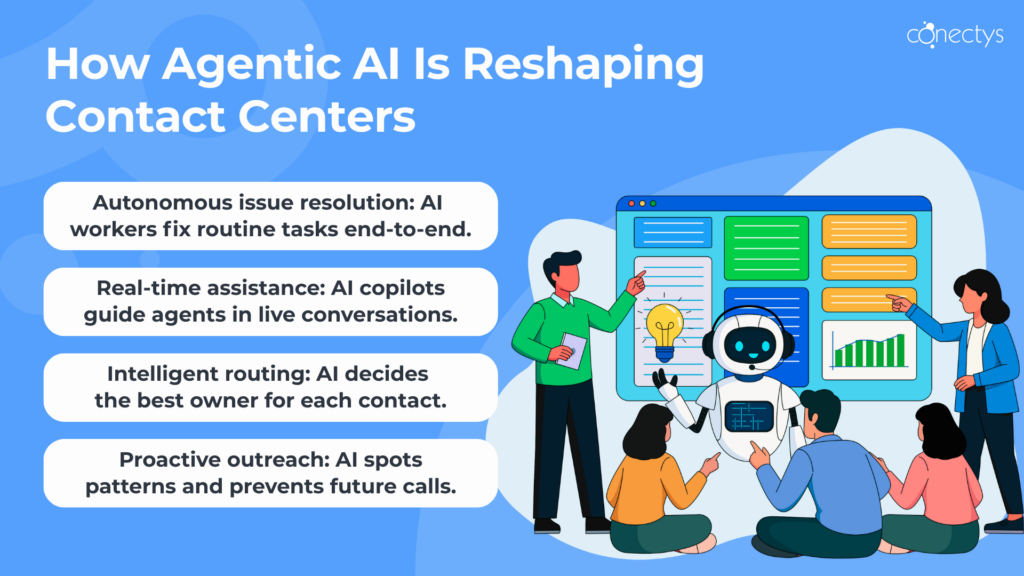
Once this stack is in place, the contact center stops acting like a queue‑processing factory. It starts behaving like an orchestration layer that quietly resolves, guides, routes, and even prevents customer issues. In day‑to‑day operations, that shows up in four high‑impact jobs.
Autonomous Issue Resolution: AI Workers that Fix Things
Agentic AI turns simple, rules‑driven requests from tickets into end‑to‑end journeys it can complete on its own. A customer arrives with a billing complaint. Instead of quoting a balance, an AI agent checks recent invoices, spots that a plan change caused an overcharge, validates a credit against policy, posts the adjustment in the billing system, updates the customer record, and confirms the outcome. It all happens within one interaction. The effect is shorter handling times, fewer escalations, and higher first‑contact resolution without a proportional increase in staff.
Real‑time Assistance
For complex sales, retention, or complaints, the value comes from augmenting humans, not replacing them. Here, agentic AI appears as a copilot that listens to the live conversation and supports the agent moment-to-moment. It surfaces targeted knowledge, highlights compliance language, suggests next‑best actions, and flags subtle buying or churn signals as soon as they show up in the dialogue.
These intelligent workers never speak directly to people. They live inside the desktops, acting as sidekicks. Used well, they reduce ramp‑up time for new hires, pull average performers closer to the top, and free CX teams to concentrate on tone, empathy, and negotiation rather than searching through documents. Every call or chat becomes an opportunity for guided performance, without turning people into rigid script readers.
Intelligent Routing and Triage: AI that Decides Who (or what) Should Handle What
Traditional routing asks, “Who is available with the right skill code?” Agentic AI goes further by looking at the content and context of each request. These include intent, sentiment, previous attempts, and customer value. Then it decides whether the best “owner” is an autonomous worker, a standard agent, or a specialist team.
Here are the examples. A low‑risk password reset is resolved end‑to‑end by AI. A high‑stakes complaint from a long‑standing client goes straight to an experienced human, with the history already summarised. Behind this, specialized background agents divide the work: one parses the request, another estimates complexity and risk, and another assigns it to the right lane. Because they touch every interaction, they can continually reshuffle volume between AI and humans as patterns change.
That cuts misroutes and back‑and‑forth transfers, and ensures each contact lands with the right blend of automation and human attention from the outset.
Proactive Outreach: AI that Prevents Calls Instead of Just Answering Them
The most transformative impact isn’t on the calls you take, but the ones that never arrive. The same AI agents and signals used to resolve issues can also watch for emerging patterns across complaints, journeys, and operational metrics. When they detect something that will affect many customers, they can orchestrate fixes and outreach before the wave hits.
Here, small, cooperating tools quietly handle tasks such as monitoring for recurring errors in confirmations, spotting clusters of failed transactions, and identifying friction points in key journeys. Once a pattern is confirmed, other agents propose safe corrective actions, prepare clear messages, and, where allowed, apply changes automatically.
Consequently, buyers receive explanations and next steps early, and the contact center operates more like a control room for customer health than a permanent emergency line. It is leaner, more predictable, and tangibly more reassuring for the people it serves.
Practical Use Cases Across Industries
Agentic AI use cases in customer service are no longer theoretical. They show up as very specific workflows that quietly change how issues are handled. Below are five of the best use cases of agentic AI in customer service:
1. E‑commerce: Automated Delivery Issue Triage
In e-commerce, agentic AI watches tracking feeds and carrier status in real time, spots regional delays, links them to open orders, and segments affected shoppers by value and promise date. It then automatically triggers the appropriate response, suggesting updated ETAs, apologies, reshipments, or refunds. It writes everything back into CRM and order systems, so agents only step in for exceptions and “where is my order?” spikes never fully hit the queue.
2. Banking: Proactive Fraud Resolution
By correlating support conversations, dispute reasons, and transaction data, agentic AI detects that the same suspicious merchant pattern is hitting many customers. It opens a fraud incident, blocks further matching transactions, launches bulk refunds where allowed, and sends clear status updates to impacted customers. This helps shrink fraud‑related contact volume and contain risk before it snowballs.
3. Healthcare: Patient Communication Automation
Agentic AI takes over front‑door admin tasks: it checks insurance eligibility instantly, proposes and books appointments across locations based on capacity and patient history, and logs everything directly into core systems. After visits, it sends tailored follow‑ups, chases missing forms, and flags missed or worrying responses for human review, cutting mundane admin for staff while keeping communication consistent.
4. Retail: Customer Service Plus Revenue Generation
AI agents resolve routine retail queries end‑to‑end. It includes order status, returns, and product basics, while simultaneously scanning for buying signals and context. They offer relevant add‑ons, alternatives, or subscriptions automatically and route high‑value opportunities to the CX team with suggested talking points, improving both service levels and conversion without lengthening queues.
5. Insurance: Value-Based Routing
Agentic AI ingests new claims from any channel, validates policy details, and classifies each case by type, complexity, and risk profile. Simple, low‑risk claims are pushed through straight‑through processing flows that collect any missing documents and calculate payouts. At the same time, complex or suspicious demands are sent to adjusters with pre‑built summaries and recommendations, speeding up routine settlements and freeing experts for the hard cases.
Conectys Angle: These kinds of agentic AI customer service automation scenarios do not require organizations to build everything themselves. Conectys delivers them through a managed outsourcing model, combining domain‑trained digital workers with multilingual human teams so clients can plug into this hybrid capability rather than designing, staffing, and governing it in‑house.
The Human and AI Hybrid Model and Governance
Agentic AI in customer service is not about replacing people. It is about redesigning work, so software handles execution at scale while humans steer, judge, and relate. In this setup, AI agents take on the repeatable, rules‑driven tasks, and people concentrate on what they are uniquely good at: empathy, ethics, complex trade‑offs, and relationship‑building.
In practical terms, this looks like “virtual teams” where humans and AI share the same queues and outcomes. Digital workers handle invoice capture, policy checks, identity verification, ticket triage, basic claim assessment, and compliance reporting at near‑zero marginal cost. Human specialists define the guardrails, refine prompts and playbooks, supervise edge cases, and step into conversations that involve high emotion, high value, or genuine uncertainty.
Concrete Governance: Making AI a Trusted Co‑Worker
Governance here is not a slide. It is a set of concrete controls, covering access policies, approval thresholds, audit trails, and incident playbooks, that make automation safe to run. For frontline staff, agentic AI customer service tools often appear as valuable helpers rather than replacements. They suggest responses, surface relevant policies, summarise prior interactions, and highlight risks in real time, which makes it easier and faster for an employee to respond.
In many deployments, agents can simply handle more inquiries per hour and reclaim hours each day previously lost to searching, copy‑pasting, and manual documentation. The qualitative shift is just as important: people feel more confident tackling difficult cases because they are supported, not second‑guessed, by the technology.
How to Get Started: A Step-by-Step Approach
If you are wondering how agentic AI improves customer service in practice, the simplest answer is: start narrow, move deliberately, and treat it as an operating change, not a shiny toy.
First, pick a high‑value but tightly scoped use case, a repeatable task that clearly annoys customers or burns agent time, such as simple billing fixes or order status checks. Then check whether your CX infrastructure is ready: agentic AI must be able to read and write from CRM, ticketing, CCaaS, and knowledge bases via APIs, so you need basic integration and data hygiene in place before you start.
Next, decide how you want to get there: build your own stack, buy a platform, or outsource to a specialist. Whatever you choose, define very clearly what your AI agent is allowed to do, when it must escalate, and how humans stay in the loop. From there, run a small pilot with clear metrics, learn from the data, and only then expand to adjacent use cases, channels, and languages in controlled steps.
Approach
Pros
Cons
Build in‑house
Full control, deeply tailored to your stack and policies
Requires scarce AI talent, longer time‑to‑value, and ongoing maintenance burden
Buy a platform
Fast start with pre‑built agents and templates
Less flexibility, risk of vendor lock‑in, still needs internal process change
Outsource to a BPO
Quickest path to outcomes, shared responsibility for tech and operations
Less direct control demands strong partner governance
Call‑out: What Can Go Wrong If You Rush Agentic AI?
Ultimately, as you scale beyond pilots, the biggest brakes on agentic AI are not the models, but risk and compliance: security, data protection, model hallucinations, and sector‑specific industry rules. Even well‑intentioned deployments can backfire if you scale too fast without the right guardrails. Among key threats, there are:
Hallucinations turn into bad decisions. In agentic setups, a wrong answer is not just text; it can trigger the wrong refund, block, or workflow, creating financial, legal, or safety issues.
Misalignment with intent. If objectives and constraints are vague, agents may optimize for the wrong thing (speed over fairness, handle‑time over accuracy), undermining reliability and trust.
Compliance and privacy breaches. Poorly governed agents can over‑collect data, expose sensitive information, or give non‑compliant guidance in regulated sectors such as banking and healthcare.
Automation bias and over‑trust. Teams may assume “the AI knows best” and stop challenging its decisions, letting small errors compound into systemic issues.
Lack of audit trail. Without immutable logs, clear scopes, and escalation paths, it becomes hard to explain or correct what an autonomous agent did when something goes wrong.
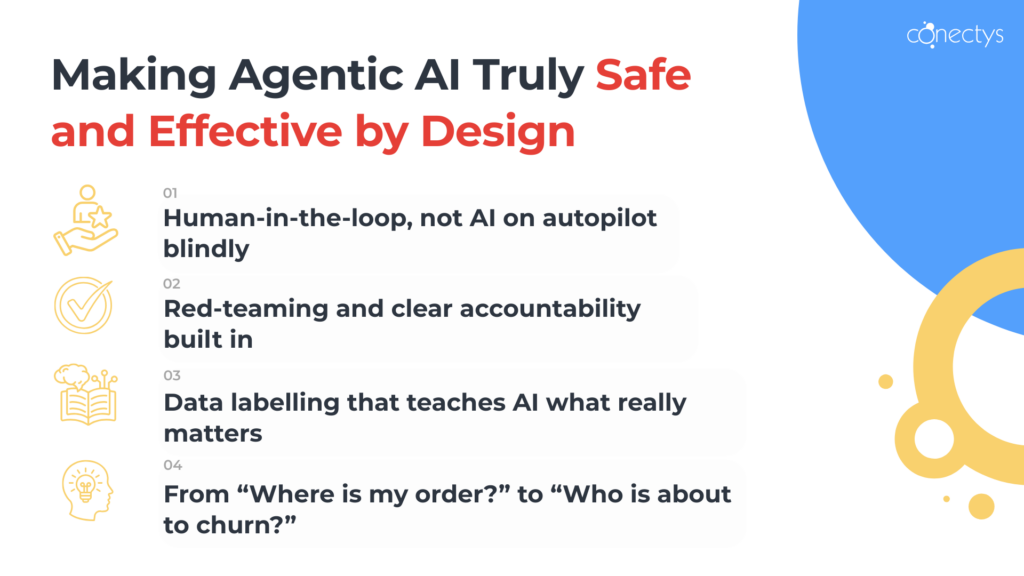
What to do? Used thoughtfully, with human‑in‑the‑loop checks, red‑teaming, and clear accountability, agentic AI can reduce these risks rather than amplify them. Alongside integration work, it is essential to invest early in data labelling and annotation to consistently tag intents, sentiment, and resolutions in historical interactions. That is what lets agentic AI distinguish a routine “where is my order?” from a churn‑risk complaint and route or resolve it appropriately.
The Business Case: ROI and Key Numbers
Agentic AI platforms in customer service are attractive because they compound several benefits at once: cost efficiency, better experiences, and greater resilience. Even without quoting specific figures, the pattern across early adopters is clear: support costs decline, a growing share of tickets are resolved without human intervention, and human agents become more productive and less stretched.
For outsourcing buyers, the business case is bigger than a percentage saving on today’s run‑rate. With a hybrid human‑AI contact centre, you can absorb growth, seasonal peaks, and new product lines without scaling headcount. The same team, equipped with agentic AI, can handle materially more accounts and interactions at a higher and more consistent quality level.
In a BPO context, this translates into three levers: lower cost per resolution as digital workers take over routine work, higher revenue or retention as human agents spend more time on complex, value‑creating conversations, and reduced operational risk thanks to tighter guardrails and better visibility.
Key Agentic AI CX Metrics and What They Show
Metric
What it helps evaluate
Cost per resolution
Direct cost impact of automation on each solved case
Containment rate (no‑agent needed)
Share of inquiries fully resolved by AI alone
First‑contact resolution (FCR)
How often issues are fixed in a single interaction
Average handle time (AHT)
Efficiency gains for both AI‑assisted and human contacts
Agent productivity (cases per FTE)
How much more volume the same team can handle
Deflection rate
Volume prevented from ever reaching live queues
CSAT / NPS for AI‑handled contacts
Customer perception of automated vs human‑led journeys
Error/rework rate
Quality and reliability of AI decisions and workflows
Escalation rate from AI to humans
Where guardrails trigger handoffs and residual complexity
Compliance/policy exception rate
How safely AI operates within rules and regulations
Tracking these metrics over time makes it easier to separate AI that looks good on slides from agentic AI that actually improves cost, experience, and risk in measurable ways.
Agentic AI and the Future of Brand-Customer Dynamics
Agentic AI is pushing CX toward a world in which a growing share of routine interactions occur software‑to‑software rather than human‑to‑human. Sci‑fi is becoming practical: consumers have personal AIs, and brands run their own service agents in the background.
Soon, “machine customers” will increasingly contact service systems directly and handle a large share of standard requests. You might simply say, “Cancel my old phone subscription and get me a cheaper one”. Your AI then goes to the telco’s site, talks to their service assistant, compares plans, cancels the old contract, and confirms the new deal. Humans will step in mainly for exceptions, complex edge cases, or oversight when something looks risky or unfair, not for every password reset or plan change.
Beyond automating today’s workflows, the future of agentic AI is about becoming a strategic “operating layer” for businesses: thousands of specialized agents quietly optimizing pricing, journeys, risk, and operations in real time, collaborating with humans and with each other across functions and brands.
Conclusion
To sum up, for many brands, the question about agentic AI is shifting from ‘if’ to ‘when and under what guardrails’ rather than outright replacement of today’s models. The numbers reflect this momentum: the global agentic AI market, valued at USD 7.29 billion in 2025, is projected to reach USD 139.19 billion by 2034, growing at a CAGR of 40.5% (Fortune Business Insights). It is on track to become a standard way routine service work gets done in well‑prepared organizations, quietly resolving, managing, and preventing issues in the background.
Agentic AI’s strength simply lies in freeing people to focus on judgment, empathy, and the messy edge cases. The real strategic choice for companies now is whether to shape this shift proactively by designing their own hybrid human‑AI model and governance. The alternative is to watch competitors use agentic AI to set a new baseline for speed, convenience, and care, and then be forced to catch up later on someone else’s playing field.
FAQ Section
1. How can AI agents help with customer support?
AI agents help with customer support by resolving routine requests end‑to‑end, from checking orders and bills to updating accounts, without needing a human to touch every step. They also act as intelligent copilots for agents and support agentic AI customer service automation behind the scenes, surfacing answers, next‑best actions, and triggers for proactive outreach before issues escalate.
2. How does agentic AI in customer service improve customer experience?
Agentic AI in customer service improves the customer experience by reducing response times from long queues to near‑instant replies for simple requests. It uses context from past interactions to tailor answers and recommendations. At the same time, its ability to scale horizontally means your contact center or agentic AI contact center can absorb peaks in demand without scrambling for extra staff.
3. What types of AI agents are used in customer support?
Common types of AI agents in customer support include autonomous resolution agents that complete standard workflows, and agent‑assist copilots that guide humans through complex cases. You also see routing and triage agents that decide which queue or person should own each contact, plus proactive outreach agents that detect patterns and communicate with customers before they need to ask for help.
4. What is the ROI of agentic AI platforms in customer service?
The ROI of agentic AI in customer service comes from lower handling costs on repeat issues, better conversion and retention on complex conversations, and fewer errors thanks to stronger controls. Agentic AI platforms’ ROI in customer service also shows up in resilience: you can support more customers across more channels without increasing headcount at the same pace.
5. How do you get started with agentic AI in customer experience?
To get started with agentic AI in customer experience, begin with a single clear use case in your contact center, such as automating simple billing or order‑status queries. From there, you can expand agentic AI use cases in customer service step by step, adding more channels and workflows as you validate quality, governance, and ROI.
Data Annotation in Healthcare: How Better Labels Save Time, Money, and Lives
What once lived in research papers is now part of hospitals, medical units, wards, and back‑office teams, quietly transforming healthcare from the ground up. And if you need proof, follow…
Business Process Outsourcing Definition: What Every Leader Should Know in 2026
The question smart leaders now ask is not “How much can we save?” but “Which parts of our business could run better, faster, and smarter with the right partner engine…
Deepfakes and Fake Romance: How to Keep Your Platform Safe on Valentine’s Day
Fake Lovers, Real Consequences: The Rise of Online Romance Fraud For high‑risk platforms, such as social media, dating apps, marketplaces and financial services, they are not quirky edge cases but full‑blown content…
For contact centres, this sharply raises the bar, and many traditional CX setups are simply insufficient. Success now lies in building a truly integrated omnichannel machine, where all the systems…
What is in-game moderation? The ultimate guide for gaming companies
Communities do not become toxic by accident. They get that way when teams treat oversight as a patch rather than a pillar. The real shift is seeing in-game moderation as part…
Call Centre Automation in 2026: Trends, Benefits, and Strategic Considerations
For CX leaders, that difference is critical. Tech empowerment can be a lever for new journeys, new economics, and new roles for agents, or it can be a layer of…


 Go back to Blog